
9 Overlapping Predictions That, Collectively, Explain Why Open Source Will Mostly Replace Commercial MMM Implementations Sometime in the Next Five Years

At various points in the past year (at the 2025 Game Revenue Optimization Mini-Summit and, more recently, on LinkedIn), I’ve been an advocate for a take that makes some people uncomfortable:

Open Source is Going to Dominate the Future of Commercial MMM.

When I say that in private conversations, I usually get one of two flavors of pushback.

  1. “Sounds like a big change. What do you mean by dominate?”
  2. “You do game revenue optimization for a living — talking about the future of MMM isn’t exactly in your swim lane. Why do you care?”

The second question is easy. In mobile games, marketing measurement isn’t an analytics side quest — it’s part of the core loop. If you can’t measure incrementality, you can’t compute marginal Return on Advertising Spend (ROAS) or forecast payback. If you can’t compute marginal ROAS or forecast payback, you can’t scale. And since GDP occasionally gets retained to help evaluate user attribution and marketing measurement systems and build roadmaps, our customer base is effectively saying: “Yes, GDP, this is precisely your swim lane.”

The first question is harder, because “open source will dominate” is imprecise and implies a significant change in the market. Let’s start by defining dominate.

By dominate, I mean the default foundation for serious MMM implementations will be open-source frameworks like Meridian or PyMC and that most commercial value will move up-the-stack into integration, operations, governance, and domain-specific modeling.

How will this happen? The rest of this article contains a set of predictions for how the commercial landscape of MMM technology will evolve over the next 3–7 years (and why I think that the excellent provider maps from Marketing Science Today are going to change dramatically as a result).
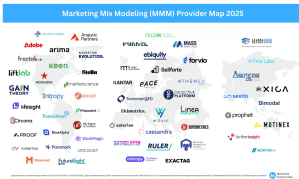
Marketing Science Todays MMM Provider Map.
MMM Provider Map from https://marketingscience.today/

This article is formulated as a set of nine specific predictions that, collectively, justify the claim that open source is going to dominate the future of MMM.

Before we get started, it’s important to note that, conceptually, an “MMM implementation” divides into four pieces:

  • The core computational engine and algorithms (aka “engine and modeling capabilities”). This is the hard data science code and is also commonly referred to using the following names: model layer, inference engine, and model training engine.
  • A set of applications that use the trained model provided by the MMM to make recommendations (e.g., spend optimization and revenue forecasting).
  • A structural model and set of data definitions. This is the data-modeling part of the job and is also commonly referred to by the following names: model structural form, measurement framework, data and metrics taxonomy, schema & definitions, or semantic model.
  • A set of integrations into data sources and production processes to run the engine / algorithms.

The first claim I’m making is that open source will take over the first two bullet points. And the second claim I’m making is that, depending on company size, companies will either do the work associated to the last two bullet points themselves, or use an industry/vertical specific provider that leverages the open-source frameworks from the first two bullets (Larger companies will roll their own; smaller companies will use a vendor).

And, of course, if you’re the sort of person who likes their predictions laced with some empirical validation, everything I’m talking about in this article is already happening (per William Gibson, the future is already here. It’s just not evenly distributed).

Here, for example, is a recent post from LinkedIn:

MMM vendors are increasingly losing deals to the open source platforms.
Source: https://www.linkedin.com/feed/update/urn:li:activity:7407778595366125568/

With that said, let’s get started.

Prediction #1: No Private Vendor Will Maintain a Durable “Engine and Modeling Capabilities” Edge Over Open Source Frameworks

If you’ve worked in software long enough, you know how this goes.

A core technology becomes strategically important and broadly applicable. Open-source communities form. Enterprises start contributing. Vendors stop competing on the core algorithms and software capabilities, and start competing on packaging, workflow, and services.

And here are three examples from recent history:

MMM is lined up for the same pattern because it has the same properties as databases, operating systems, and orchestration frameworks. That is, it has:

  • High strategic value. Being able to optimize advertising spend is mission-critical for most companies.
  • Low “technical secret sauce.” MMM has sixty years of academic research behind it and the core ideas are well-understood. The core ideas have been refined, and re-refined, and most MMM engines have easily understood structural models.
  • MMM is not core competence. For most companies, MMM is an analytical tool that helps them allocate advertising spend more effectively. From a business perspective, the real differentiation is elsewhere (product, brand, …).
  • A constant need to evolve in response to platforms changes. In fact, the modern resurgence of MMM, at least in some verticals, dates back to Apple’s decision to change privacy rules (for the current rules on iOS, see Apple’s ATT docs and Apple’s SKAdnetwork docs)
  • A shared problem structure across companies. This will be revisited more extensively below in Prediction #6. For now, suffice it to say that two educational software companies that ship mobile apps and charge a subscription are very likely to have similar MMMs implementations, and there is little or no point to them investing in building the underlying technology.
  • A huge premium on transparency and trust. In many ways, this is part of “high strategic value.” If a tool is being used to make important decisions, it needs to have a high level of transparency and trust. And MMM is especially vulnerable to open-source standardization because the trust surface area is huge: inputs, priors, assumptions, diagnostics, and decomposition logic all need to be inspectable.

The first three of these argue that companies will outsource development of MMM technology. The last two imply that if your commercial moat is “our engine and algorithms are better but we can’t tell you why because trade-secret,” you might run into problems as the market matures.

Prediction #2: Most Major Companies Will Run Internal MMM Systems On Top of an Open-Source Codebase

The first part of this prediction centers around the following question here: at scale (say, $100M in annual media spend), should a company rely on an MMM run by an MMM vendor? The answer is that, for many brands, this doesn’t make sense. Instead, most large-scale advertisers should and will run and maintain MMM systems internally, even as they lean on external experts for initial setup and periodic checkups.

Why? Because at a certain scale, the MMM isn’t a model or an algorithm or a separate piece of software. It’s part of a much larger system comprised of

  • Data contracts with a large number of other marketing systems.
  • Features engineered on top of proprietary data (which, in many cases, cannot be shared or has to be scrubbed extensively before sharing for compliance reasons).
  • Integrated experimentation layers.
  • Stakeholder workflows, customized dashboards, and integrations to internal planning and financial systems.
  • Repeatable forecasting routines.

All of this is incorporated into an internal suite of truth, and is tied to mission-critical, highly visible, processes that are often company specific (that is, the decision to bring the MMM in-house mostly means owning the data contracts, the refresh cadence, governance, experiment and integration, …. not re-inventing Bayesian inference).

And once a company decides to use an internal system, the decision to leverage robust open-source framework is an easy one to make.

This trend is already visible. Google’s Meridian is explicitly positioned as enabling advertisers to run in-house MMM. And Meta’s Robyn was built for “in-house and DIY modelers,” with published case studies including in-house applications.

Robyn’s documentation is clear: the goal is to support in-house modeling.
(Taken from https://facebookexperimental.github.io/Robyn/docs/analysts-guide-to-MMM/)

The interesting second-order effect is contribution. Once enough big companies run open-source MMMs in production, they’ll start contributing code and fixes back. Not out of charity, but because maintaining private forks is expensive and they want the ecosystem to solve shared problems in standard ways (like clean room inputs, reach/frequency handling, calibration tooling, and standardized diagnostics).

That flywheel is why open source solutions tend to accelerate once they reach critical mass (and it’s also why private solutions, once they fall behind, never catch up). And accelerating flywheels lead to dominant solutions.

Prediction #3: The Two “Leading Open-Source Bayesian MMMs” Will Become Fundamentally Different Systems Over Time

Right now, the two Bayesian open-source platforms that are leading the conversation are Google’s Meridian and PyMC-Marketing’s MMM.

They’re both Bayesian. They’re both open source. But they don’t feel like the same product at all.

(If you want a deeper comparison, there are already multiple comparisons floating around, including a head-to-head benchmark from PyMC Labs and some excellent practitioner writeups. See, for example, this comparison from early 2025 or this pair of articles from PyMC)

My take is simple:

  • If you’re resource constrained and need a tighter “path to value,” Meridian’s ease of use is a very nice feature. Both Google and the community will lean into that, making MMM easily accessible to a large number of lightly-resourced companies.
  • If you have strong internal modeling expertise and you need to build something bespoke (hierarchical, multi-outcome, time-varying, experiment-informed coefficients, …), PyMC-Marketing is the more extensible base. And PyMC will lean into that, in the process becoming the enterprise toolkit for MMM.
  • This gap will widen over time because Meridian will optimize for adoption and repeatability, while PyMC will optimize for extensibility and enterprise-grade composability.

Of course, these first three predictions are the backbone of the prediction everyone wants to argue about.

Prediction #4: By 2030, Many Enterprises Will Run “Open-Source MMM / In-House Team / Ecosystem Contributions”

Today, most enterprise MMM “systems” are still a patchwork of legacy martech tools, bespoke SQL, and spreadsheet glue—refreshed quarterly or semi-annually and dependent on a few heroic analysts. That’s why this shift will feel less like “switching models” and more like infrastructure modernization: once the core technology is standardized, the real work becomes building durable data contracts, QA, governance, and decision workflows around it.

The general pattern is the same one we’ve seen elsewhere:

  • MMM is becoming infrastructure.
  • Infrastructure gets standardized.
  • Standardization favors open source.
  • Enterprises keep control of the instance, the data, and the business logic.

The best mental model here is Kubernetes. Kubernetes won not because one vendor stayed ahead forever, but because it became the standard substrate that everyone extended: cloud providers, security tooling, observability, deployment pipelines, and internal platform teams. MMM is headed toward the same kind of ecosystem. Once a handful of large advertisers operationalize open-source MMM, you’ll see an explosion of “everything around the model”: data connectors, calibration pipelines, scenario tooling, automated QA, governance, and decision workflows.

And this is where contributions become inevitable. In practice, “contributing back” won’t look like brands publishing their spend curves or revealing confidential information. It will look like bug fixes, stability improvements, new diagnostics, better infrastructure for priors, standardized data schemas, and reference implementations for common patterns (geo hierarchies, reach/frequency, promotions, creative fatigue). Those are the shared problems that everyone wants solved once and then maintained by the community.

So, the MMM vendor category doesn’t disappear. Instead, it moves up-the-stack, from “owning the engine” to “owning deployment, governance, integrations, and vertical packaging.”

Prediction #5: Most Providers in the “MMM Platform Map” Will Be Forced to Pivot (Or Become Commoditized)

If you look at provider maps like the one above from Marketing Science Today, you’re basically looking at a snapshot of a market where most of the enterprise value is currently held by:

  • Proprietary implementations.
  • Bespoke onboarding and integrations.
  • Customer lock-in.
  • Opaque modeling decisions that are hard to replicate.

Once the open-source substrate becomes standard, a substantial percentage of that value simply evaporates.

Which Vendors Will Survive?
AI-Generated MMM Provider Map Circa 2030

Some vendors will still win—not by owning the engines and algorithms, but by owning integrations into clean rooms and walled gardens, governance/model risk tooling, change management, and the operational layer that makes MMM usable week-to-week.

MMM consultants will continue to prosper by offering specialized services (in much the same way that Percona helps companies get the most out of their open-source databases). Enterprises will have internal MMM teams that know the business deeply. They’ll still need help with the initial development of their MMM, and specialist help when things go south in a complicated way.

And some companies will offer “MMM as a service” on top of the open-source platforms. I expect that the way this will roll out is that a company will develop deep expertise in a specific vertical (see the next prediction), and operate and maintain the MMM in production for smaller companies (that don’t want to have expertise in keeping an MMM running). Note that these will be relatively thin layers on top of open-source frameworks.

What won’t prosper is proprietary engines or algorithmic / data-science code.

Prediction #6: Verticalized MMM Becomes a Real Category (And It Will Look Like “Open-Source / Hosting / Domain Expertise”)

Here’s the (slightly) exaggerated version of an important claim:

Companies in the same vertical need the same MMM (in everything except the data. And mostly the same data too)

This is not a new insight. In 2005, in an article entitled Market Response Models and Marketing Practice Hanssens, Leeflang and Wittink talked about “standardized models” and “the availability of empirical generalizations.” And in 2009, in an article entitled Market Response and Marketing Mix Models:
Trends and Research Opportunities
, Bowman and Gatignon explicitly talked about “Industry Specific Contexts.” Newer work and meta-analyses show that response patterns can be meaningfully different in specific sectors (e.g., entertainment), limiting naïve transferability and strengthening the case for vertical-specific defaults, priors, and diagnostics.

To make this more concrete, consider the following verticals:

  • Subscription digital goods (streaming, SaaS-ish consumer apps, memberships). Focus: long payback windows and retention-driven growth. Core issues: linking media to CAC/LTV, cohort behavior, and delayed revenue realization (making outcome measurement unreliable).
  • Mobile video games / live-service games. Focus: both acquisition and re-engagement, with marketing organized around strong content beats. Core issues: mixed performance + brand dynamics, event-driven baselines, platform signal loss, overlapping measurement systems, creative fatigue, and the need for high-frequency (daily/weekly) budget adjustments.
  • DTC e-commerce for physical goods. Focus: heavy paid social/search, promotion calendars, and operating within inventory constraints. Core issues: major confounders from merchandising/pricing/promo strategy, and separating media effects from cultural events and seasonality (e.g., holidays).
  • Omnichannel retail (brands with physical stores and online commerce). Focus: coordinating a wide mix of legacy and digital media across multiple purchase paths. Core issues: inconsistent measurement units (e.g., GRPs vs. impressions), geo/store hierarchies, distribution changes, attributing media to footfall vs. online activity, and disentangling holiday-driven demand from true incrementality.
  • QSR / food delivery (fast food, restaurants with delivery, delivery aggregators). Focus: local demand generation with always-on promotion strategies, increasingly tied to digital outcomes (e.g., app installs, online orders). Core issues: localized dynamics, promo-driven demand shifts, weather sensitivity, competitive pressure, and multi-outcome measurement across in-store and digital channels.
  • Healthcare services / providers (health systems, urgent care, dental/ortho, telehealth). Focus: high-consideration decisions with conversions that often occur offline (calls, intake, scheduling) and vary heavily by geography. Core issues: multiple outcomes (inquiries, appointments, treatments, and revenue), long and variable lags in ad response, capacity constraints (clinician supply and scheduling), compliance concerns, and confounders like payer mix/open enrollment cycles, network changes, local competition, and seasonal demand shocks.
  • … (feel free to add Education, Insurance, … )

Each of these verticals is clearly distinct from the others (the requirements for digital subscription goods are very different from those for healthcare), and each is ripe for a standardized model and SaaS services built on top of hosted open source.

That is, companies in a single vertical aren’t identical, but they are similar enough that you can build a single verticalized MMM system. Such a system would have:

  • A canonical data model / structural form.
  • A set of priors and response curve defaults.
  • A standard set of confounders.
  • A standard set of integrations to vertical-specific tools.
  • And a standard reporting workflow.

Note also that building this, in the open-source world, requires deep domain expertise, and just-enough MMM expertise to encode the right confounders and workflows (but not the kind of research-grade modeling and coding effort required to build the core framework). In other words, this is best done as a layer on top of the open-source MMM toolkits that are already available.

I also expect that many of these companies will actually be “spun-out” from companies already doing business in the vertical (in the same way that Discord began life as the communication layer of Fates Forever).

The prediction is that the open-source community will build and maintain the hard data-science parts, as both out of the box systems and as extensible toolkits, and the vertical-specific hosting companies will build and maintain the domain specific models (and compete on domain expertise, not MMM expertise)

Prediction #7: After Vigorous Debate, the Industry Will Converge on What “Accurate MMM” Means (And It Won’t Be a Single Number)

Right now, the idea of “accuracy” is a mess. Two different groups of people, or two different MMM providers, can both say “our MMM is highly accurate” and mean completely different things. For example, they could mean:

  • The model has high R² (or RMSE. Or NRMSE, NMAE, …)
  • The model has good out-of-sample prediction error (e.g., using one of RMSE / MAPE / wMAPE / sMAPE / MASE, NRMSE, NMAE, …)
  • The model backtests well.
  • The model matches lift test and incrementality tests.
  • When we run the MCMC sampler again, we get the same results (note that we’re not including sampler metrics, like BFMI, in this list because they matter for reliability, whether we can trust the outcome of the sampler, but aren’t about accuracy).
  • The results are stable under time-series cross-validation.
  • The decomposition looks plausible to domain experts.

In order to progress, the industry has to move toward a layered standard that looks like:

  1. Predictive sanity checks (R², RMSE, MAPE, wMAPE, etc.) with vertical-specific values for “good” and “great” performance (e.g., a 10% wMAPE is probably excellent in omnichannel retail, but not nearly as impressive in subscription digital goods).
  2. Stability checks (time-slice CV, holdouts, parameter stability)
  3. Decomposition plausibility (no insane baselines, response curves make sense to industry experts, and so on)
  4. Calibration / validation against experiments (geo lift, conversion lift, interrupted time-series analysis)

Note that everyone is starting to talk about accuracy and performance measurements more seriously. Meridian’s documentation explicitly states the goal is causal inference, and that out-of-sample prediction metrics are useful guardrails but shouldn’t be the primary way fit is assessed. Similarly, PyMC-Marketing explicitly documents evaluation workflows and time-slice CV, including Bayesian scoring like CRPS and Recast has been a staunch advocate for stability and robustness.

The consensus will be less like “everyone uses metric X” and more like “everyone uses a shared evaluation playbook which is customized by vertical.”

Prediction #8: “Interoperability in the Marketing Stack” Will Stop Meaning “Everything has a Dashboard”

Today, most marketing systems are tied together at the dashboard level. System A produces a chart. System B produces another chart. A smart human stares at both charts and then decides what to do.

That’s not interoperability in any real sense. That’s parallel usage (possibly accompanied by “storing the data in the same relational database”)

In the next iteration of marketing measurement, interoperability will mean:

  • Shared metric definitions.
  • Shared data sets.
  • Machine-readable outputs.
  • And automated decision workflows (with humans supervising, not translating).

AI is going to accelerate this, not because LLMs magically fix data, but because they dramatically reduce integration friction.

Protocols like MCP (Model Context Protocol) are basically “standard tool interfaces for AI systems,” and they’re already being applied to analytics. AI tools enable companies to deal with messy and unstructured data and dramatically lower the barriers to system integrations. Ad Exchanger recently published a nice summary of the value of MCP but the key point is simply this: the adoption of MCP is spreading rapidly (for example, Google ships a Google Analytics MCP server so an LLM can connect to GA4 data directly, you can manage your Facebook ads via MCP, analytics vendors like Mixpanel have adopted MCP, and so on). Once MMM outputs and measurement systems are exposed through standard interfaces, LLM-driven agents can:

  • Map schemas across platforms
  • Translate metric definitions
  • Generate and maintain transformation code
  • And reconcile “same concept / different naming” problems that currently require senior analysts and significant amounts of tribal folklore.

This is the tedious plumbing work that marketing stacks have always needed… and never staffed adequately. And now it’s, if not easy, doable.

Prediction #9: Standardization Creates Shareable Datasets, Enabling Academic Research that Will Accelerate Model Progress

In the long run, standardization creates three things (that don’t exist today at scale):

  1. Benchmark datasets (mostly synthetic and semi-synthetic) with known ground truth as well as standard definitions for metrics and data elements.
  2. A shared evaluation suite (the “accuracy playbook” from Prediction #7, but runnable as code).
  3. Privacy-safe collaboration patterns that let companies share researchable artifacts without sharing raw sensitive data.

Once those exist, academics can stop doing “MMM research in the void” and start iterating against problems that look like production.

There are already efforts aimed at connecting academics, advertisers, and vendors around MMM research (e.g., industry initiatives convening multiple stakeholders). The next step will be a shared evaluation suite — not just “use RMSE,” but a versioned set of tests that any MMM implementation can run: rolling time-slice CV, stability checks, decomposition plausibility checks, calibration scoring against experiments, and distributional scoring where appropriate.

In other words: an MMM will be able to pass or fail a standardized battery of tests the way software passes unit tests.

Once the community has that, we get something we’ve never had: comparability. Practitioners can argue about assumptions instead of arguing about whose dashboard looks nicer. Vendors can compete on reliability and usability. And researchers can publish results that actually translate back into practice because everyone can reproduce them.

Did I Make a Mistake? Surely the Future Isn’t This Predictable

This article contains 9 fairly specific predictions about the future of MMM. Each of the predictions is plausible and reasonably well-supported (I could add more supporting details, but we’re already at almost 4,000 words).

If I’ve done my job well, you agree with six or seven of the predictions and have reservations about two or three of them. But you’re probably still on the fence about whether the MMM provider community is about to implode as their customer base standardizes on top of open-source MMM frameworks.

That’s okay. The goal was to start a conversation.

The point of view here is that we are in the “suddenly” part of the famous Hemingway quote.

“Gradually, and then suddenly” — Hemingway was talking about going bankrupt, but the quote applies to almost every major change. Things start slow and then accelerate.

But timing is hard.  Bill Gates might very well wind up with the last word. “We always overestimate the change that will occur in the next two years and underestimate the change that will occur in the next ten.”

If Your Incrementality Model Is “Better,” Ship the Test Suite

(AKA Why “Trust Us, It’s Better” Is the Wrong Way to Ship Measurement Algorithms)

A new algorithm just dropped in the marketing measurement ecosystem.

And I had a very mixed reaction.

On one hand: Heck Yeah. I love seeing teams invest in making geo-testing and incrementality analysis more reliable. This stuff is hard. The world is noisy. Decision-makers want something actionable, not an uncertainty interval that’s wider than a barn door.

On the other hand: Sigh. the announcement was basically “we built a new thing, it’s better than the open source equivalents, trust us.” The claim is that it produces less biased estimates, narrower intervals, and better calibration. But without sharing much about the method or the test suite that backs those claims up.

I’m excited about innovations in incrementality. I’m less excited about black-box measurement claims—especially when teams and budgets depend on them.

Why I care (and why this keeps coming up)

For context: GDP sometimes does UA benchmarking and measurement diagnostics—assessing a customer’s current setup (MMM, incrementality, vendor stack), and then giving them a roadmap for improvement.

These engagements usually include some form of vendor analysis (e.g. helping our customers make build vs buy decisions). And in my experience, a meaningful fraction of MMM / incrementality vendors do not share technical details about how their models work.

That usually triggers three red flags for me:

  1. One evolutionary (the “Bill Joy” problem)
  2. One practical (the “don’t grade your own homework” problem)
  3. One ideological (the “measurement is a shared scientific inheritance” problem)

Let’s talk through them.

Red Flag #1: The World Will Out-Innovate You (aka Joy’s Law + Open Innovation)

Bill Joy’s famous line is:

“No matter who you are, most of the smartest people work for someone else.”

A straightforward consequence of Joy’s law is that most innovation happens elsewhere. And that your job, as a company, should include systematically surveying and learning from the wider ecosystem (as a side-note, it’s not a coincidence that Bill Joy’s work on Unix was a key enabler of the open-source revolution).

The academic literature goes one step further: you should not only systematically survey and learn from the wider ecosystem. You should also give back. Knowledge-sharing can be a rational, value-creating strategy, because it attracts external effort and converts it into your advantage. Here’s two important papers on this subject:

  • Lerner & Tirole’s economics work explains how open source participation can be motivated by things like career concerns and reputation—and why that’s not just altruism.
  • Their later synthesis makes the case that a lot of open source dynamics are explainable using standard economics (theories of labor and industrial organization), i.e., it’s not “vibes,” it’s incentives.

Note also that firms don’t necessarily have to go “fully open.” There’s a well-studied middle ground: selective revealing. Joachim Henkel’s work on embedded Linux describes firms revealing selectively—sharing meaningful chunks of firm-developed innovation to get external support and ecosystem benefits, while still protecting some competitive IP.

In a later paper, Henkel, Schöberl, and Alexy go further: they describe how customer demand for openness can trigger a positive feedback loop, and eventually openness becomes a new dimension of competition.

That last sentence is the key: once open-source takes hold, and once openness becomes competitive, “closed by default” becomes an evolutionary dead-end. Which means that when a vendor, any vendor, announces a new algorithm but won’t disclose method details or evaluation infrastructure, in an area where there is a credible and growing open-source presence, my spidey-sense starts to tingle. Is this actually an improvement on the state of the art? And, even if it is, is it about to get obsoleted by the open ecosystem?

This question matters a lot because switching costs are real. How can I recommend a vendor to my customers if I suspect that their systems are going to become obsolete in short order?

Red Flag #2: Don’t Grade Your Own Homework (Especially in Measurement)

The second pragmatic red flag is simpler:

When a vendor is the only one who can evaluate the vendor’s product, we’re doing marketing and not science.

A black-box algorithm and a proprietary test suite and self-reported “we’re better” claims is very hard to assess responsibly (especially if, like GDP, you’re advising customers and their budgets). And while a potential customer could, in theory, use a free-trial period to do the comparison themselves, most customers don’t have the ability to do that (and especially don’t have the ability to do that across a suite of potential vendors). Not to mention that having every potential customer do a bakeoff against a suite of vendors is monumentally inefficient.

Acknowledging the importance of verification is a great starting point. But it’s almost meaningless if the details of the verification aren’t fully available.

The PyMC case study: a rare “this is how you do it” moment

This is why I was genuinely happy to see the PyMC Labs team publish an apples-to-apples MMM benchmark comparing PyMC‑Marketing and Google’s Meridian.

What they did right:

  • They explicitly set out to create and publish a rigorous technical benchmark on realistic synthetic datasets covering different scales (from “startup” to “enterprise”).
  • They aligned model structures and used identical priors and sampling configurations to keep it fair.
  • They held a webinar and then published a video walking through the comparison.
  • They made the benchmark code publicly available on GitHub for reproducibility. The repo itself is not just a toy notebook. It’s a benchmarking suite with data generation and parameter recovery tooling, and it explicitly supports comparing inference methods/libraries.

Even if you disagree with their modeling choices, you can do something extremely powerful:

You can argue with the algorithms and the code instead of arguing with the vibes.

Nico Neumann deserves a special callout here. His LinkedIn post about the PyMC <-> Meridian comparison generated one of the most informative LinkedIn threads in recent memory.

That’s how a field levels up. And it’s the ecosystem pattern I’d love incrementality vendors to lean into more often:

  • Publish methodology details
  • Publish test suites
  • Publish failure modes
  • And compete on product + implementation + support, not secrecy

Red Flag #3: Measurement is a Shared Scientific Inheritance (and Secrecy Slows the Whole Genre)

Here’s the more ideological point:

MMM and incrementality aren’t new. These tools are built on decades of rigorous academic work, plus a growing body of open-source implementations:

We are all building on shared foundations. And when vendors keep core methodology opaque, the science progresses slower, trust erodes faster, and customers lose confidence more easily.

Evaluating Our Predictions for 2025

For the most part, the gaming industry runs on a yearly cyclical cadence (there are large-scale decades-long trends and patterns, such as Joost Van Dreunen’s Play Pendulum, but the yearly cycles are how the industry self-organizes). So, for example, if it’s March, it’s time for GDC (and welcome once again, my friends, to the Game Revenue Optimization Mini-Summit). And if it’s December, it’s time for the pundits to gather round and tell us what will happen in the coming year.

Right now we’re in the prelude before the prediction bonanza, the calm before the storm, that long moment when the baby has been dropped on the floor but has not yet started screaming. It’s the time of the year when the people who made the predictions ‘fess up and talk about why they were right (and how it was reality that got it badly wrong).

That’s what this is. We made some predictions last year, and we’ve been thinking hard about what’s coming next year. But we owe it to you, dear reader, to let you know how we did and to let you draw your own conclusions about how seriously to take our next set of predictions.

How We Evaluated the Predictions

We evaluated our predictions along two distinct axes:

  • Correctness. Were we right? Did our predictions come true? If what we said wasn’t true, you’d have good reason to ignore our upcoming set of predictions.
  • Completeness. Did we miss anything important? Part of the value of predicting is not just being right, it’s covering all the important events. If we were running the country and we predicted an increase in street traffic but completely missed an attack by an army of CHUD (Cannibalistic Humanoid Underground Dwellers), you’d probably wonder whether we were the right leaders.

(as a side-note, we apologize to the fans of the undergraduate logic curriculum, who are no doubt saddened that we omitted compactness as a third evaluation criteria)

Separately, there’s also the question of who evaluates the predictions. The pattern in years past, and in most of the gaming industry press, is for the predictors to self-evaluate. That is, the people who make the predictions mostly get to decide whether they did a good job.

But we’ve been told that AI changes everything. Since 2025 is the year of agentic AI, we decided to have ChatGPT (5.1, pro) evaluate our predictions using three distinct personas.

Our expert panel was comprised of generative AI simulations of:

  • A CEO of a small to midsize gaming company that is struggling to stay afloat during industry hard times.
  • An industry pundit with deep knowledge of the space and a regular platform (e.g. blog or substack).
  • An external observer, not working in the games industry but with some knowledge of the space and working in an adjacent industry, who feels somewhat skeptical about the value of year-end predictions.

Each of these personas was given the task of scoring us on both correctness and completeness.

We Were Mostly Correct

After a hearty breakfast, we convened the panel for the initial round of deliberations. Here’s the short version: We made 7 predictions. 6 came true; one came close.

The Expert Panel, Debating Correctness
(Taken During the Morning Session)

Here’s the detailed table:

PredictionCEO EvaluationPundit EvaluationSkeptical Observer EvaluationOur Reaction
There will be more revenue.This prediction has basically come true in headline terms … However, that does not mean 2025 feels like a boom.Accurate, but unexciting.Global games revenue is higher in 2025 than in 2024, but 3 to 4 percent growth against similar levels of inflation yields only a small real gain.Yes! We nailed it!
Mobile UA teams will keep leaning on MMM, often without proper validation.Directionally right.Mostly correct, but a bit pessimistic.Agree with the prediction’s spirit that many teams cling to MMM without sufficient experimentationNailed it again!
No new Top 100 mobile games without web shops will add one in 2025.Whether or not literally zero new Top 100 titles launched web shops in 2025 is hard to verify from public information and irrelevant.Too strongly worded but directionally plausible.The more meaningful observation is that web shops have rapidly become yet another layer of complexity in mobile monetization.We weren’t wrong!
Web storefronts will see big gains from experimentation and personalization.This prediction rings true in spirit. The 2025 ecosystem of DTC tooling, analytics integrations, and vendor case studies all pushes toward more experimentation and segmentation on web storefronts.Partially correct but slightly overstated.The prediction sounds plausible but I question whether, across the whole of mobile gaming in 2025, this really counts as one of the defining revenue growth engines.Still not wrong! We’re 4 for 4 so far!
AR and VR will finally gain significant traction.AR and VR do have more momentum in 2025 than a few years ago, but the impact on my business is still limited. Broadly right. The data clearly show a meaningful upswing in AR or VR and smart glasses shipments in 2025, with AI enabled glasses emerging as a genuinely new category.The prediction captures a real uptick in momentum but exaggerates how decisive 2025 is as a turning point.Yes! Right again!
Alternative app stores will exceed 10 percent of western mobile gaming installs.Overly optimistic about adoption speed. In 2025, alternative stores are a real strategic consideration, especially for EU focused titles and for Android in markets where OEM or carrier stores matter. Almost certainly incorrect given the data available in late 2025.A classic case of over extrapolating from regulatory headlines. Changing default distribution behavior for hundreds of millions of mainstream users is extremely difficult.Ouch. These judges are tough.
Selling physical goods in game will stop being surprising.Largely accurate but unevenly distributed across the industry and irrelevant to me. Mostly correct given how 2025 has unfolded.Agree that 2025 made the idea of buying physical goods inside games feel more normal.Yes! Back on track and 6 for 7 overall!

But We Missed Three Big Trends

After lunch, we reconvened the expert panel to discuss the harder question: What did we miss?

The Expert Panel After Lunch, Thinking Hard
(Mainly About Where to Go for Dinner)

According to our experts, we missed three major trends.

Prediction We Should Have MadeCEO OpinionPundit OpinionSkeptical Observer OpinionIn Our Defense
AI-native game businesses. By late 2025, most commercially serious studios will treat AI as a default part of production and live ops, and the hard problems will be ROI measurement, workflow integration, and governance, not ‘should we use AI?’My P&L reality in 2025 is that AI is the only lever big enough to offset rising costs and shrinking margins.2025’s biggest structural shift is that AI is becoming the new production function. The bottleneck in games used to be content; now it’s taste and data quality.AI is obviously big, but the ROI is opaque at this point.How did we miss this? AI is huge and transformative and we’re doing a lot of work helping companies with their AI transformations. This omission is inexcusable. Especially since 30% of the respondents to a recent GDC survey said that they believe that generative AI is having a negative impact on the games industry.
Platformized Creator Economies. By end of 2025, creator platforms like Roblox and Fortnite will represent a third major commercial pillar alongside traditional PC/console/mobile – with built‑in A/B testing, regional pricing, and engagement-based payouts that make them some of the most data‑instrumented game economies on earth.In 2025, a real strategic choice is: do we become a ‘studio on a platform’ (Roblox, UEFN) instead? This is new and a significant challenge.This is the blind spot: you treated platforms mainly as distribution and webshops, not as competing economic systems.Maybe. But are these ecosystems net-new value, or just reshuffling time and money away from other games?What can we say? After VR and then Web3, we are skeptical of platform shifts and overlooked this one.
Hybrid Monetization is the New Norm. In 2025, the median successful game will be running at least two monetization models (e.g. ads + IAP, or IAP + sub), and platform-level subscriptions will keep pulling value out of pure à‑la‑carte spending. The hard problem moves from ‘which model?’ to ‘how do we optimize LTV across overlapping ones?’”Your predictions focused on ‘more revenue’ and DTC mechanics but didn’t explicitly call out how messy monetization design has become.Hybrid monetization and subscription stacking are now the design constraint for game businesses.I don’t like it. This is starting to look like game design is just financial engineering. Games are not spreadsheets.This is business as usual and not “prediction-worthy.” Hybrid monetization was well-established heading into 2025 and isn’t really a trend. And, anyway, Tiffany Keller covered it extensively at our Game Revenue Optimization Mini-Summit in 2025.

In Conclusion

We were reasonably accurate — for the most part, the things we predicted did happen. At the same time, the events we didn’t predict are significant omissions. While our 2025 predictions captured the headline moves in revenue, UA, and monetization, our AI panel rightly called out the deeper structural shifts around AI‑native production, platformized creator economies, and hybrid monetization. It’s reasonable to say that we predicted the linear trends (that we forecasted correctly based on existing trends), but failed to anticipate the bigger non-linear shifts that will cause significant structural changes in the gaming industry.

As we head into the next prediction cycle, we’ll keep treating predictions as hypotheses to be tested, not pronouncements from on high—and we’ll try to be more explicit about the big picture changes and large-scale changes we missed this year.

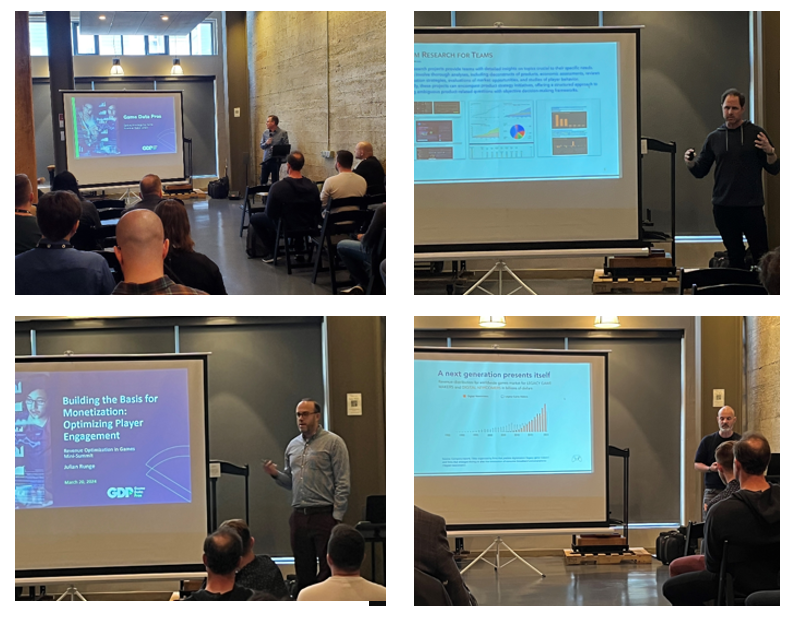
Reporting from the 2025 Game Revenue Optimization Mini-Summit

(To learn how Game Data Pros can help you optimize your games, contact us)

In 2024, we held the first-ever Revenue Optimization in Games Mini-Summit at GDC. We did it because we didn’t like that there aren’t many revenue optimization talks at GDC and that, in general, the idea of “Game Revenue Optimization” doesn’t seem to get much, if any, mindshare at industry conferences.

So, instead of grousing, we organized our own summit in 2024. The feedback we got was incredible —  the attendees loved the event, they thought the talks were amazing, and, more generally, they spent the next year asking us if we were going to do it again. 

Spoiler Alert— We did. We rented the same venue (the incredible American Bookbinders Museum), ordered a few thousand dollars worth of goat-cheese tarts and coconut macaroons, invited the world, and put on a show.

And what a show it was!

First and foremost, we had a set of world-class talks

After a brief introduction by Pallas Horwitz, the day’s emcee, the talks began at 2:15. We had five speakers.

  • Our CEO, Bill Grosso, opened the show with “10 Reasons MMMs Are More Interesting Than You Think” — an overview of how Generative AI combines with open-source libraries like Meridian to make building a good and useful MMM much more accessible to small companies than it was even 5 years ago (slides). 
  • Then Ryo Shima, CEO of JetSynthesys Japan, presented “How Game Revenue Optimization is Different in Japan” — an in-depth discussion of the behavioral differences between Japanese and Western gamers, and how that impacts monetization strategies (slides).
  • Tiffany Keller, one of the superstars at Liquid and Grit, followed Ryo and gave a talk on “Advanced Hybrid Monetization.” This was the graduate seminar version of the roundtable she held last February and was a comprehensive overview of the state of the art in hybrid monetization. 
  • And, finally, Joost Van Dreunen and Julian Runge closed the presentation part of the day by presenting a sweeping overview of the future of brand engagement with gaming (slides).
Speakers, from Left: Pallas Horwitz, Bill Grosso, Ryo Shima, Tiffany Keller, Julian Runge, and Joost Van Dreunen.

Second, we had an amazing audience

Like last year, we were slightly nervous about this — the room only holds 105 people, and we had 340 people registered. Ultimately, we decided to issue 180 tickets. 75 people came, most stayed for the entire summit, and the event turned into a caffeine-fueled group conversation about revenue optimization. 

As a side note, the audience included at least one certified game design legend among the other luminaries. 

Third, the happy hour was delightful

“Most awesome part of GDC.” — Evan Van Zelfden

The combination of the incredible speakers and the amazing audience meant that the happy hour was more than just an excuse to have salmon brioches and artichoke salad while downing plastic glasses of red wine. The food was good, but the conversations were excellent and lasted until the museum closed.

The Game Revenue Optimization Mini-Summit Rides Again

Want to learn more about revenue optimization in gaming? Join us for the Revenue Optimization in Games Mini-Summit and Happy Hour at 2 PM on March 19 at the American Bookbinder’s Museum in downtown San Francisco.

We’re a little over two weeks away from our yearly GDC event (signup here) and I’m really excited. This is our once-a-year community-building event where we take some time to talk revenue optimization with our peers, as a community, and it’s looking incredible.

We’ve got a great schedule:

  • The doors open at 2:00. We’ll have coffee for people who had a lot of carbs at lunch.
  • At 2:15, I’m kicking things off with “MMMs Are More Useful Than You Think.”
  • At 2:40, Ryo Shima will talk about “How Revenue Optimization is Different in Japan.”
  • At 3:05, Tiffany Keller will speak on “Advanced Hybrid Monetization.”
  • At 3:30, there will be a brief coffee-break. Note also that there will be cookies and coffee available throughout.
  • At 3:40, Joost Van Dreunen and Julian Runge will present a special double-length talk on “Gaming’s New Game: How Brand Partnerships Are Reshaping Entertainment Marketing.”
  • From 4:30 to 5:30, we’ll have a reception. Great hors d‘oeuvres from a grazing station along with various beverages.

That’s an amazing set of speakers and talks. But, to be honest, I’m equally excited by the audience. I’ve been looking at the people who’ve signed up, and –wow — the list is extraordinary. There might just be some legends in attendance.

The talks will be great, the side conversations (we’ve got the entire first floor of the American Bookbinder’s Museum and there are a couple of rooms that are perfect for follow-on conversations) will be awesome, and the reception will take it to the next level.

We’d love to have you join us.

2025 Games Industry Predictions Roundup 

As we head into 2025, one thing is clear: the gaming industry has no shortage of would-be-Nostradamuses. Predictions are flying by at high speed, sometimes as lists on LinkedIn and sometimes as full-fledged articles.  

Image by Terrence Dorsey

I made my own predictions, Seven Things That Are Really Going To Happen in 2025, last week. This week, to help everyone get a sense of what’s coming, the team gathered a few of our favorite prediction articles into a single list.  


First and foremost, of course, are Dean Takehashi’s yearly predictions. Dean is the games journalist and helpfully includes an analysis of his previous predictions and how he did in 2024.  VentureBeat also has a good list of 2025’s best sellers.  

The brain trust at Deconstructor of Fun has come out with their 6 Predictions. They have a strong focus on geopolitical trends, and also think we’re headed for a new era of AI realism. They also have a set of Mobile Games Marketing Predictions that are interesting.

GamesIndustryBiz, as usual, is focused on large-scale business events and trends. Their panel of industry-watchers review their calls for the past year and offer new forecasts for the year to come

Eric Seufert and Mobile Dev Memo are a definitive source for mobile marketers, and Eric published his 2025 year-ahead predictions related to mobile marketing and mobile gaming for the 11th year running (paywall). 

PocketGamer held a gathering of mobile mavens and collected their thoughts in a three-part series on mobile gaming in 2025.  

DFC Intelligence and Geekwire teamed up to tell us what will happen as well, Gaming industry trends to watch in 2025: Distribution channels, console wars, and more, focusing on distribution channels and console gaming.  

MIDiA Research published five trends they think are key, including an interesting take on the rise of portable devices. Everyone expects the Switch 2 to ship. But … Microsoft and Sony shipping portable devices as well? That is a bold prediction. 

As you might expect, Esports Insider has some thoughts on the future of esports, and 2025 looks set to be a milestone year for the industry. Also included: a link back to their industry insiders’ 2024 predictions

Servers.com focused on trends in live services in gaming, including an unusual prediction about AI (it will help reduce operational costs). 

And, as mentioned previously, Game Data Pros has analyzed the trends and has seven predictions about how game revenue optimization will evolve in 2025.


Got a favorite that we missed? Let us know and we’ll add it to the list.  

Community Perspectives on Our Article About Observational Causal Inference

A few weeks ago, GDP’s Bill Grosso and Julian Runge wrote an article about the potential pitfalls of observational causal inference modeling—Combating Misinformation in Business Analytics: Experiment, Calibrate, Validate—with a particular focus on Media Mix Modeling. The article originally appeared as a guest post on Eric Seufert’s Mobile Dev Memo and has also been reposted on the GDP blog. It sparked a wide variety of comments on LinkedIn (and an article on Ad Exchanger), and we decided to collect the community response.

But before we get to the responses, let’s quickly summarize the background for writing the article in the first place.

Evidence increasingly reveals that observational causal inference (OCI)—methods that infer cause-and-effect relationships from existing data—often leads to misjudgments about the impact of business strategies. Unlike randomized controlled trials (RCTs), OCI relies on naturally occurring data patterns, which are susceptible to biases and unobserved variables. These inaccuracies can result in flawed conclusions about business effectiveness, risking wasted resources and harm to market position. Accurate insights are vital for guiding investments, pricing, and marketing strategies, making rigorous experimental validation essential in contexts where causality drives financial and strategic outcomes.

Bill and Julian discuss the limitations of OCI in business analytics, citing methods like Media and Marketing Mix Modeling (m/MMM), which often misattribute causality due to issues like endogeneity and omitted variable bias. They advocate for prioritizing experimental approaches, such as A/B tests and RCTs, to establish causal clarity. Additionally, they recommend using experimental results to calibrate observational models, correcting biases and improving accuracy. By integrating experimentation with model calibration, businesses can enhance analytics reliability and make better-informed decisions.

Photo by John Schnobrich on Unsplash

Two Significant Recent Papers that Prompted the Original Article

The pace of academic articles about possible issues with observational causal inference has increased in recent years. In particular, Julian and Bill cited two recent papers. The first paper was Observational Price Variation in Scanner Data Cannot Reproduce Experimental Price Elasticities, by Robert Bray, Robert Evan Sanders, and Ioannis Stamatopoulos. 

The authors analyzed 389,890 randomized in-store supermarket prices across 409 products in 82 test stores and found that experimental price elasticity averaged -0.34, while observational data from 34 control stores suggested an elasticity of about -2.0. This highlights a significant mismatch between observational and experimental estimates of demand elasticity. Observational data suggest that retailer prices are in the elastic range, whereas experimental results indicate pricing in the inelastic range. This discrepancy cannot be attributed to typical factors like estimator properties, price variation processes, or elasticity timeframes. The findings challenge the reliability of observational demand elasticity estimates and raise questions about standard economic models’ applicability to retail pricing. 

Julian and Bill also cited Close Enough? A Large-Scale Exploration of Non-Experimental Approaches to Advertising Measurement, by Brett R. Gordon, Robert Moakler, and Florian Zettelmeyer, in which the authors evaluate the accuracy of non-experimental methods in estimating the causal effects of digital advertising. Utilizing data from 15 Facebook advertising experiments across 11 brands, the researchers compare experimental results with those derived from observational models, including matching, inverse probability weighting, and regression. The findings reveal that these non-experimental approaches often produce biased estimates, with the direction and magnitude of bias varying across brands and methods. This variability underscores the challenges of relying on observational data for advertising measurement. 

Concurring Commentary from AdExchanger

James Hercher, in his article Learning To Love And Let Go Of Attribution Models on AdExchanger, makes a strong case for our article, saying that while mix models and other attribution approaches have been essential tools for understanding marketing impact, they often fall short in today’s complex media landscape.  

Hercher highlights the limitations of models like media mix modeling (MMM) and multi-touch attribution (MTA), which can misattribute causality due to factors such as endogeneity and unseen variables behind emerging MMM tooling, echoing the concerns we raise in our article.

There are other reasons not to trust the MMM trend as a ‘truthier’ attribution fallback, now that multitouch attribution and user-lever tracking is infeasible.

And that’s because MMM might just become another walled garden platform plaything.

Earlier this year, Google open-sourced its own MMM product, which it calls Meridian. Meta has an open-source MMM solution it calls Robyn, while Amazon’s is still a proprietary product, not open-source.

But platform MMM is the same as platform anything. It’s there to prove the platform succeeded, as much as that your marketing worked. Google’s Meridian, for example, is really good at tying together search, YouTube, TV and Google Ads campaigns.

Hercher argues that these traditional models, while helpful in a simpler media environment, are now less effective at navigating the fragmented, multichannel advertising landscape. Instead, he supports our emphasis on integrating experimentation and validation, underscoring that models should not be relied upon as standalone truths. He agrees that mixing empirical experimentation, such as A/B tests, with calibration of observational data allows marketers to correct for biases and improve attribution accuracy.  

Hercher’s view aligns with our stance that business analytics must move beyond traditional attribution models and embrace an iterative, hybrid approach to better capture the causal effects of marketing strategies and guide informed decision-making. 

Discussion in the Community 

The article also resonated with many of our peers in the community, generating a variety of thoughtful comments and discussions after Bill and Julian posted their article on LinkedIn. 

The team at Haus, a startup marketing science platform that helps companies measure the incremental ROI of online and offline ad spend, had a lot to say about our take on MMM and causal analysis. 

Zach Epstein, Founder and CEO at Haus, agrees in principle and notes that experiments are hard: 

This is a great article that covers a lot of the issues we see day in and day out. What I think is less appreciated, especially in the world of advertising, is how difficult it is to run great experiments. The concept of running experiments alone won’t solve this problem – there’s a tremendous need for increasing access to world class methods and infrastructure.  

Running an experiment is easy. Running an experiment that you’d bet your own money on is extremely difficult. 

Chandler Dutton, who works on Customer Success at Haus, also agrees in principle and points out that, in practice, results do not match models

This piece thoughtfully explains not just why I’ve been insistent on every brand I know needing to work with a partner like Haus, but why I joined the team. 

Too often, marketing teams are chasing outputs from observational modeling only and trying to use those to inform multi-million dollar decisions without those models being able to prove causality. Whether for its own sake or for the purpose of calibrating such observational models, experimentation is critical and the only path towards getting really actionable data.  

I’ve seen teams chase their modeled attribution results and not have their resulting investments drive the results the model pointed towards. I’ve also seen teams drive incredible success without really knowing why and what to do next to pour gasoline on the fire. The missing piece is experimentation. I’d recommend all of the growth marketers in my network read this one. 

Olivia Kory, who works on Incrementality Testing at Haus, also agrees we need experiments

Dr. Julian Runge and William Grosso just released a very important guest essay in Eric Seufert’s Mobile Dev Memo about the shortcomings of observational causal inference modeling, specifically MMM. In their words: 

Evidence is mounting that observational causal inference (aka MMM) often misinforms about the actual impact of business strategies and actions, and this means we need more experimentation — for baseline evaluation of policies, for validation of observational insights, and for calibration of observational models. 

“When a new drug is tested, RCTs are the gold standard because they eliminate bias and confounding, ensuring that any observed effect is truly caused by the treatment. No one would trust observational data alone to conclude that a new medication is safe and effective. So why should businesses trust OCI techniques when millions of dollars are at stake in digital marketing or product design?” 

Photo by charlesdeluvio on Unsplash

Others in the community also reacted strongly to the article. 

Tony Williams, an Economist and Director of Data Science at FlowPlay, agrees and wonders if a greater focus on advanced data science techniques (matching methods, et al) might help: 

Definitely excited to read this since I’ve spent the last few days looking at valid matching methods for multiple variants and have been surprised that the academic literature hasn’t covered this more. I know you’re looking at something different (MMM), but as someone who loves experimentation, there are also times we need other methods.  

Very cool to see this discussion getting brought up! 

Jim Kingsbury, an E-Commerce Marketing Advisor who has worked with Zappos, Allbirds, KiwiCo, and Amazon, agrees and lists vendors who routinely do AB tests to verify models:

Running geo-lift tests to validate – or, if needed, calibrate – the output of an MMM is becoming table stakes. 

This essay is a great reminder of how important this is. 

To marketing leaders out there who are using or evaluating MMM solutions, I recommend asking the vendor about their process to validate what their model claims.  

If the vendor hems & haws in response to this question, I’d recommend finding other vendors who enthusiastically embrace this critical step. 

A few vendors I know who always do this include: 

  • SegmentStream 
  • WorkMagic 
  • LiftLab 

I’m sure there are others who do this and I’m excited for anyone reading this post to share who they are. 

A longer back-and-forth discussing the comparison of MMM to drug trials occurred between Jimmy Marsanico, VP of Product at Prescient AI, and Toma Gulea, Lead Data Scientist at Polar Analytics, debating whether comparing marketing to other verticals makes sense: 

I appreciate the focus on measurement rigor, but the paper’s comparison of marketing measurement to drug trials misses some crucial real-world complexity. In clinical trials, control groups get placebos in isolation. But in digital advertising, ‘control’ users are actively shown alternative ads competing for the same share of wallet. When a control user purchases a competitor’s product after seeing their ad instead of yours, they’re naturally less likely to buy your product – not because your ad wouldn’t have worked, but because they already spent their budget elsewhere. This makes the ‘untreated’ state anything but neutral, potentially leading experiments to undercount true advertising impact. 

While empirical tools like incrementality tests provide valuable data, treating any single approach as ‘table stakes’ oversimplifies the challenge. The most successful brands recognize that marketing measurement is more art than perfect science – they triangulate insights from multiple sources (sometimes by leveraging dynamic and regularly updated MMMs, like that of Prescient AI ) and combine them with strategic thinking and domain expertise. 

After all, isn’t the goal to make better decisions, not just chase methodological purity? 

Toma replied: 

Jimmy M. But that’s actually what you want to test. For example if you were to cut your spending overall on a channel, what you describe would happen (consumers shifting to competitors) and that’s exactly these external factors you want to account for when evaluating the true impact of your ads. Am I wrong? 

Jimmy clarified his take on the differences between marketing and drug trials. 

Toma Gulea 🤔 I’m not quite sure we’re saying different things here. The comparison and example of pharmaceuticals is just inherently different in the approach of test/control groups because during a hold out test, your competitors aren’t holding out (but during a pharmaceutical test you’re not taking a competitor’s drug to treat your symptoms). 

Alluding to your other comment below, you’re right — if you’re going to cut spend on a channel (or double it perhaps), if you’ve only spent the same amount daily on that channel, or campaign, there’s less data (or confidence) in the relationship of spend to revenue at any other spend value — making it a model to help make decisions, not a perfect crystal ball to predict impact of ALL future changes. Thus, my argument against “table stakes” — there is value… but only when used appropriately — that applies to any measurement tool. 

And Toma concluded that there are more parallels than differences: 

The principle is the same: isolating the effect of a treatment (or ad exposure) to estimate causal impact. Your competitor’s ad becoming more effective as a result of a change in ad exposure is absolutely part of the causal impact you want to test. The only difference with Pharma is the elimination of the “Placebo effect”.  

Even in pharma, participants in control groups don’t exist in a vacuum—Consider a holdout test for a new pain medication. Some participants in the control group might be taking over-the-counter pain relievers during the trial, while the treatment participants are not. The intervention still caused participants to stop the alternative medication, leading to a better or worse outcome. 

The only thing an RCT can give you is the impact of the intervention on the outcome in the real world, not the mechanism. 

Your change in ad spend causes a drop in revenue because of competition, then so be it—that’s the real-world outcome you’ll get, just like an outcome for a medication is influenced by the use of an alternative medicine. 

Randomized control trials are often impractical, unfeasible, or too costly, and other methods should be employed. But an RCT is an RCT, and the comparison with pharma is absolutely correct.  

Separately, Toma Gulea made an interesting general observation about the differences between claims and the actual value of using MMMs. 

A typical claim from MMM vendors: “testing the model’s accuracy on a separate holdout period ensures its trustworthiness”.  

This misses the core purpose of an MMM. The real goal isn’t simply to predict revenue based on past marketing spend, but to uncover the causal relationship between channel spending and revenue outcomes. The key question is: ‘What would happen if I spent X?’ In situations where the marketing spend has been stable over time, evaluating accuracy on historical data is meaningless because it doesn’t assess how the model will perform when actual changes occur. When it does, your MMM will break and you will realize it’s useless. 

The right approach requires a causal lens: 

  • Start by understanding the business and marketing strategy to identify confounders and latent variables. 
  • Then, apply causal methods and gather control and instrumental variables. 
  • Avoid the lure of “predictive accuracy”: you can’t observe the true relationship you are trying to model. The goal is to have a useful model! 

Kenneth Wilbur, Professor of Marketing and Analytics at the University of California, San Diego – Rady School of Management, made the interesting point that experimentation was viewed as important in the early papers but somehow dropped out of daily practice:

Some of the original MMM literature in the 1950s pointed out that MMMs obviously needed to be calibrated with experimental variation in spending. 

An Operations-Research Study of Sales Response to Advertising, by M. L. Vidale and H. B. Wolfe (1957), demonstrates the necessity of precise, reproducible data to evaluate advertising effectiveness. Through controlled experiments, the authors identified key parameters—Sales Decay Constant, Saturation Level, and Response Constant—that define sales responses to advertising campaigns. These parameters enable the development of predictive mathematical models to optimize advertising efforts and budget allocations. The study emphasizes that well-designed experiments provide actionable insights for tailoring strategies to maximize return on investment, underlining the critical role of empirical data in refining marketing decisions.

A Media Planning Calculus, by John D. C. Little of MIT and Leonard M. Lodish of the University of Pennsylvania (1969), emphasizes the importance of experimentation in developing an effective marketing or MMM strategy by introducing a structured approach to media planning, known as the Media Planning Calculus, and recommending experimental calibration wherever feasible. The authors advocate for controlled experiments and computational modeling to measure and predict market responses to advertising. By integrating concepts like exposure frequency, forgetting, audience segmentation, and diminishing returns, the study demonstrates how experimentation refines parameter estimations, such as exposure values and response functions. This empirical grounding allows for dynamic optimization of advertising schedules and budgets, significantly improving marketing efficiency.

It is awesome to be reminded of these papers that already called out the necessity for experimental calibration of OCI and m/MMM almost 60 years ago.

We are very excited by the positive reception of our analytics strategy opinion piece. GDP is committed to precise analytics and driving forward best practices in gaming and beyond. 

Combating Misinformation in Business Analytics: Experiment, Calibrate, Validate

This article originally appeared as a guest post on Eric Seufert’s Mobile Dev Memo, written by Dr. Julian Runge, an Assistant Professor of Marketing at Northwestern University, and William Grosso, the CEO of Game Data Pros.

Observational Causal Inference (OCI) seeks to identify causal relationships from observational data, when no experimental variation and randomization are present. OCI is used in digital product and marketing analytics to deduce the impact of different strategies on outcomes like sales, customer engagement, and product adoption. OCI commonly models the relationship between variables observed in real-world data.

In marketing, one of the most common applications of OCI is in Media and Marketing Mix Modeling (m/MMM). m/MMM leverages historical sales and marketing data to estimate the effect of various actions across the marketing mix, such as TV, digital ads, promotions, pricing, or product changes, on business outcomes. Hypothetically, m/MMM enables companies to allocate budgets, optimize campaigns, and predict future marketing and product performance. m/MMM typically uses regression-based models to estimate these impacts, assuming that other relevant factors are either controlled for or can be accounted for through statistical methods.

However, MMM and similar observational approaches often fall into the trap of correlating inputs and outputs without guaranteeing that the relationship is truly causal. For instance, if advertising spend spikes during a particular holiday season and sales also rise, an MMM might attribute this increase to advertising, even if it was primarily driven by seasonality or other external factors.

When a new drug is tested in a clinical trial, randomized control trials are the gold standard because they eliminate bias and confounding, ensuring that any observed effect is truly caused by the treatment. No one would trust observational data alone to conclude that a new medication is safe and effective. While not usually dealing in questions of life and death, the stakes in business analytics can also be very high. Solely relying on observational causal inference is a risk that needs to be taken in full awareness of the limitations of the approach. (Photo by Michał Parzuchowski on Unsplash) 

Observational Causal Inference Regularly Fails to Identify True Effects

Despite its widespread use, a growing body of evidence indicates that OCI techniques often stray from correctly identifying true causal effects. This is a critical issue because incorrect inferences can lead to misguided business decisions, resulting in financial losses, inefficient marketing strategies, or misaligned product development efforts.

Gordon et al. (2019) provide a comprehensive critique of marketing measurement models in digital advertising. They highlight that most OCI models are vulnerable to endogeneity (where causality flows in both directions between variables) and omitted variable bias (where missing variables distort the estimated effect of a treatment). These issues are not just theoretical: the study finds that models frequently misattribute causality, leading to incorrect conclusions about the effectiveness of marketing interventions, highlighting a need to run experiments instead.

A more recent study by Gordon, Moakler, and Zettelmeyer (2023) goes a step further, demonstrating that even sophisticated causal inference methods often fail to replicate true treatment effects when compared to results from randomized controlled trials. Their findings call into question the validity of many commonly used business analytics techniques. These methods, despite their complexity, often yield biased estimates when the assumptions underpinning them (e.g., no unobserved confounders) are violated—a common occurrence in business settings.

Beyond the context of digital advertising, a recent working paper by Bray, Sanders and Stamatopoulos (2024) notes that “observational price variation […] cannot reproduce experimental price elasticities.” To contextualize the severity of this problem, consider the context of clinical trials in medicine.

When a new drug is tested, RCTs are the gold standard because they eliminate bias and confounding, ensuring that any observed effect is truly caused by the treatment. No one would trust observational data alone to conclude that a new medication is safe and effective. So why should businesses trust OCI techniques when millions of dollars are at stake in digital marketing or product design?

Indeed, OCI approaches in business often rely on assumptions that are easily violated. For instance, when modeling the effect of a price change on sales, an analyst must assume that no unobserved factors are influencing both the price and sales simultaneously. If a competitor launches a similar product during a promotion period, failing to account for this will likely lead to overestimating the promotion’s effectiveness. Such flawed insights can prompt marketers to double down on a strategy that’s ineffective or even detrimental in reality.

Prescriptive Recommendations from Observational Causal Inference May Be Misinformed

If OCI techniques fail to identify treatment effects correctly, the situation may be even worse when it comes to the policies these models inform and recommend. Business and marketing analytics are not just descriptive—they often are used prescriptively. Managers use them to decide how to allocate millions in ad spend, how to design and when to run promotions, or how to personalize product experiences for users. When these decisions are based on flawed causal inferences, the business consequences could be severe.

A prime example of this issue is in m/MMM, where marketing measurement not only estimates past performance but also directly informs a company’s actions for the next period. Suppose an m/MMM incorrectly estimates that increasing spend on display ads drives sales significantly. The firm may decide to shift more budget to display ads, potentially diverting funds from channels like search or TV, which may actually have a stronger (but underestimated) causal impact. Over time, such misguided actions can lead to suboptimal marketing performance, deteriorating return on investment, and distorted assessments of channel effectiveness. What’s more, as the models fail to accurately inform business strategy, executive confidence in m/MMM techniques can be significantly eroded.

Another context where flawed OCI insights can backfire is in personalized UX design for digital products like apps, games, and social media. Companies often use data-driven models to determine what type of content or features to present to users, aiming to maximize engagement, retention, or conversion. If these models incorrectly infer that a certain feature causes users to stay longer, the company might overinvest in enhancing that feature while neglecting others that have a true impact. Worse, they may even make changes that reduce user satisfaction and drive churn.

The Problem Is Serious – And Its Extent Currently Not Fully Appreciated

Nascent large-scale real-world evidence suggests that, even when OCI is implemented on vast, rich, and granular datasets, the core issue of incorrect estimates remains. Contrary to popular belief, having more data does not solve the fundamental issues of confounding and bias. Gordon et al. (2023) show that increasing the volume of data without experimental validation does not necessarily improve the accuracy of OCI techniques. It may even amplify biases, making analysts more confident in flawed results.

The key point to restate is this: Without experimental validation, OCI is at risk of being incorrect, either in magnitude or in sign. That is, the model may not just fail to measure the size of the effect correctly—it may even get the direction of the effect wrong. A company could end up cutting a channel that is actually highly profitable or investing heavily in a strategy that has a negative impact. Ultimately, this is the worst-case scenario for a company deeply embracing data-driven decision-making.

A/B tests, geo-based experiments, and incrementality tests can help establish causality with high confidence and calibrate and validate observational models. For a decision tree guiding your choice of method, e.g., consider Figure 1 here. In digital environments, the gold standard of conducting a randomized control trial is often feasible, for example, testing different versions of a web page or varying the targeting criteria for ads. (Photo by Jason Dent on Unsplash) 

Mitigation Strategies

Given the limitations and risks associated with OCI, what can companies do to ensure they make decisions informed by sound causal insights? There are several remedial strategies.

The most straightforward solution is to conduct experiments wherever possible. A/B tests, geo-based experiments, and incrementality tests can all help establish causality with high confidence. (For a decision tree guiding your choice of method, please see Figure 1 here.)

For digital products, RCTs are often feasible: for example, testing different versions of a web page or varying the targeting criteria for ads. Running experiments, even on a small scale, can provide ground truth for causal effects, which can then be used to validate or calibrate observational models.

Another approach is bandit algorithms that conduct randomized trials in conjunction with policy learning and execution. Their ability to learn policies “on the go” is the key advantage they bring. This however requires a lot of premeditation and careful planning to leverage them successfully. We want to mention them here, but advise to start with simpler approaches to get started with experimentation.

In reality, running experiments (or bandits) across all business areas is not always practical or possible. To help ensure that OCI models produce accurate estimates for these situations, you can calibrate observational models using experimental results. For example, if a firm has run an A/B test to measure the effect of a discount campaign, the results can be used to validate an m/MMM’s estimates of the same campaign. This process, known as calibrating observational models with experimental benchmarks, helps to adjust for biases in the observational estimates. This article in Harvard Business Review summarizes different ways how calibration can be implemented, emphasizing the need for continuous validation of observational models using RCTs. This iterative process ensures that the models remain grounded in accurate empirical evidence.

In certain instances, you may be highly confident that the assumptions for OCI to produce valid causal estimates are met. An example could be the results of a tried-and-tested attribution model. Calibration and validation of OCI models against such results can also be a sensible strategy.

Another related approach can be to develop a dedicated model that is trained on all available experimental results to provide causal assessments across other business analytics decisions and use cases. In a way, such a model can be framed as a “causal attribution model.”

In some situations, experiments and calibrations may not be feasible due to budget constraints, time limitations, or operational challenges. In such cases, we recommend using well-established business strategies to cross-check and validate policy recommendations derived from OCI. If the models’ inferences are not aligned with these strategies, double- and triple-check. Examples for such strategies are:

  • Pricing: Purchase history, geo-location, or value-based pricing models that have been extensively validated in the academic literature
  • Advertising Strategies: Focus on smart creative strategies that align with your brand values rather than blindly following model outputs
  • Product Development: Prioritize features and functionalities based on proven theories of consumer behavior rather than purely data-driven inferences

By leaning into time-tested strategies, businesses can minimize the risk of adopting flawed policies suggested by potentially biased models.

If in doubt, err on the side of caution and stick with a currently successful strategy rather than implementing ineffective or harmful changes. For recent computational advances in this regard, take a look at the m/MMM package Robyn. It provides the ability to formalize a preference for non-extreme results in addition to experiment calibration in a multi-objective optimization framework.

To see clearly and avoid costly mistakes, treat observational causal inference as a starting point, not the final word. Wherever possible, run experiments to validate your models and calibrate your estimates. If experimentation is not feasible, be critical of your models’ outputs and cross-check with established business strategies and internal expertise. Without such safeguards, your business strategy could be built on misinformation, leading to misguided decisions and wasted resources. (Photo by Nathan Dumlao on Unsplash)

A Call to Action: Experiment, Calibrate, Validate

In conclusion, while OCI techniques are valuable for exploratory analysis and generating hypotheses, current evidence suggests that relying on them without further validation is risky. In marketing and business analytics, where decisions directly impact revenue, brand equity, and customer experiences, businesses cannot afford to act on misleading insights.

“Combating Misinformation” may be a strong frame for our call to action. However, even misinformation on social media is sometimes shared without the originator knowing the information is false. Similarly, a data scientist who invested weeks of work into OCI-based modeling may deeply believe in the accuracy of their results. These results would however still misinform business decisions with potential to negatively impact share- and stakeholders.

To avoid costly mistakes, companies should treat OCI as a starting point, not the final word.

Wherever possible, run experiments to validate your models and calibrate your estimates. If experimentation is not feasible, be critical of your models’ outputs and always cross-check with established business strategies and internal expertise. Without such safeguards, your business strategy could be built on misinformation, leading to misguided decisions and wasted resources.

Why I Love Remote Work, and You Should Too! 

Game Data Pros is a remote-work company. That’s not just a description of where people work. It’s a foundational aspect of how we work together. Choosing this path for Game Data Pros offers significant advantages and raises some unique challenges we’ve grappled with. But we think a remote-first workplace provides fundamental advantages for building a team based on deep technical acumen, unique industry experience and insights, and a strong culture of cooperation and collaboration. 

This isn’t my first virtual rodeo, so to speak. Throughout my career, I spent my fair share of commuting to and from comfortable offices, noisy cubicle farms, and oddly shaped workspaces cobbled together from bookshelves and other cast-off furniture that would probably get someone in trouble with a building inspector. Or worse, racking up frequent flier miles hop-scotching between comfortable offices, noisy cubicle farms, and oddly shaped workspaces all across the country.  

Photo by Bernd 📷 Dittrich on Unsplash.

Remote work experiments have been ongoing in one form or another for decades now, and the one thing that is clear is that you have to invest some time and energy to ensure it is successful. For most of the past twenty years, companies transitioning to remote work have been part of a massive unstructured trial-and-error process to figure out how to make remote work “work!” 

I enjoyed hanging out with a lot of the people I worked with in those offices, but I don’t miss the time spent in cars and airplanes and away from my friends and family. And I think we get as much—or more—done better in the new remote-first environment. 

Over the course of my career, I have had multiple children, and it was during the first year of parenthood that I asked for one day a week to work from home. This was over twenty years ago, and while I really enjoyed missing my ninety-minute commute, I acknowledge that the world was not ready for it.

Remote meetings were not yet perfect enough to replicate a full brainstorming day and conversation. Did we need to do them daily, weekly, or monthly? Could we do our strategy sessions remotely? Certainly, as demonstrated by the progression from Polycom phones to Skype-enabled televisions to Zoom on everyone’s desktop, the technology was always improving for us to share ideas and solve problems remotely.

We can fast forward ten years and find that the world was still largely the same. I was managing teams in multiple locations. The ugly triangular Polycom phone still enabled crucial conversations because it was too easy to dismiss the humanity of someone you could only hear through a tiny speaker sitting in the middle of the table. When confronted with this challenge, I solved the problem by registering a pair of Skype accounts, one for California and one for Texas, and connecting two conference rooms visually to help bring some humanity to team interactions. The emotional arguments and disdain decreased with the amount of people seeing each other in the middle of these conversations.

In this post, I’ll share some of my thoughts about the pros and cons of remote-first workplaces. I want to tell this story because the global COVID pandemic lockdown did not create the remote-first world. It accelerated the acceptance of the inevitability of remote work. 

What We (Might) Lose When We Lose the Office 

For many roles, remote work is here to stay. If we weren’t already working remotely with success, the pandemic lockdowns demonstrated that most knowledge worker-type work—including software development—can be done effectively by completely remote teams. But plenty of people still argue for the value of in-office work. So, let’s start by examining what we lose with remote work.  

Photo by Florian Wehde on Unsplash.

In-person work is said to strengthen workplace culture and employee connections. The most common claim is that you lose “watercooler moments.” Remote work, while offering flexibility, has been associated with increased feelings of isolation and disconnection among employees. A recent study on company loyalty showed significant value in people developing friendships at work.  

Riffing on those watercooler moments, advocates for returning to in-office work have argued that physical presence fosters better collaboration and innovation. As conversations weave in and out of work subjects, you are subject to moments of spontaneous ideation, where an “aha!” moment will arise out of the conversation, spurred on by the real-time discussion with your peers. In-person interactions can lead to spontaneous idea generation and problem-solving. The “cluster effect,” where people in a shared physical space can build on each other’s ideas more effectively, is often cited as a benefit of in-office work. 

Finally, proponents of in-person work emphasize the importance of clear work-life boundaries, which can be blurred when working from home. The office environment offers a distinct separation between work and personal life, but this may also simply lead to longer hours worked rather than measurable increases in productivity. 

One could also posit that these arguments are tailored to benefit commercial real estate owners, office furniture vendors, and “seats in seats”-style management. 

Pandemic lockdowns created a unique experimental environment. Researchers have studied the correlation between decreased moments of spontaneity and the number of team members working remotely. The coming years will reveal more about what was really lost here. Several research papers with initial post-lockdown analysis have been published through the NIH, including Remote Working and Work Effectiveness: A Leader Perspective and Investigating the Role of Remote Working on Employees’ Performance and Well-Being: An Evidence-Based Systematic Review

What We Gain When We Choose Remote Work 

Some Game Data Pros team members had been working mostly or entirely remotely for years before the pandemic lockdowns, and the lockdowns simply demonstrated to a wider demographic that not only can teams continue their work remotely, but they can also grow and thrive in a remote-only environment.  

So, what do we gain with remote work?

The biggest thing we gain is time, primarily from losing a commute. That may mean gaining back anywhere from an hour to three or more hours in some areas a day, and that adds up. Individual employees get back between 20 and 60 hours per month or more. That time is irreplaceable, and when companies acknowledge the value of people’s time by allowing for remote work, you are giving them the freedom to contribute their best thinking and attention to solving problems and creating value. 

We also gain control over our schedules. This is especially valuable for people with families and pets. Doing kid drop-offs and pickups is a huge quality-of-life feature for a parent, and if you have pets, the need to walk your animals before it is dark out is a beautiful perk. Probably healthy, too. 

Remote workers have more freedom and flexibility to schedule other appointments and family commitments. Flexible schedules benefit the team’s quality of life, including being more involved with your kid’s activities such as after-school enrichment classes, community programs such as scouting, and athletic activities–including having the opportunity to coach or mentor. As a parent of a young athlete, I cannot emphasize enough how valuable this is. 

Photo by Adrià Crehuet Cano on Unsplash.

It’s still difficult to quantify the value of well-rested colleagues who have the flexibility to both be productive and take care of themselves and their loved ones. Anecdotally, having healthier people who think more profoundly about the long term makes for a better, more productive company. 

Another benefit of a remote-only team is the ability to work from almost anywhere with an internet connection. Team members can choose where they live—or travel. Location flexibility also means the company can recruit the best people from anywhere in the world rather than competing with every other company within a geographical monoculture. Instead of “we commute from South Bay vs East Bay,” the Game Data Pros team lives in 14 states and two different provinces in Canada! 

There is more room to accommodate part-time or flexible schedules. We’re able to accommodate almost-full-time schedules. For example, we have valuable team members who can only work 30 hours a week due to other commitments. That’s a lot harder for the employee if they’re driving to the office, but remote work makes it almost seamless. The company also benefits from this by keeping someone with valuable skills and experience on the team.

The final benefit of remote work is for the company itself: the company is operating rent-free! Depending on where you live, the cost of office real estate can be quite exorbitant. 

Solving the Challenges of Remote Work Creates Strong Teams

Game Data Pros has been a remote-only team from day one. We’d like to think a lot of our success is built on that foundation—hiring the best people around the world and giving them the flexibility to create wins for the company and our customers from the comforts of their home offices (or the kitchen table, or a sofa, or the backyard on a particularly nice day…). 

One of our goals is to make sure that we are an excellent company based on the best teammates. By not limiting ourselves to one or a small number of fixed geographies, we reasoned that remote work would help us attract top-tier talent wherever it exists.

First, we agree with Peter Drucker that “culture eats strategy for breakfast.” We chose to prioritize our culture and reinforce it at every opportunity. That’s why the primary pillar on which we build Game Data Pros is the “No Asshole Rule,” popularized by Robert I. Sutton in his book The No Asshole Rule: Building a Civilized Workplace and Surviving One That Isn’t. We explicitly interview to avoid individuals who consistently engage in toxic, demeaning, or destructive behavior toward others.

In offices where you have body language and nuances, it’s easier to realize the other person isn’t really an asshole. Remote? The bar is higher, and centering policies and a culture that discourages this kind of behavior from arising, focusing instead on communication, collaboration, and compassion in the first place, is key. 

Another of our many key cultural pillars is that we wish to enable people to do excellent work and become experts in what we do as a business. We explicitly dedicate multiple windows of time every week to allow people to share and learn. We have weekly knowledge transfer meetings where subject matter experts discuss their expertise and explain elements of our products and our services to help enlighten everyone. There are also monthly brown bags that are more tactical and focused on expert subjects within teams. We estimate that the typical Game Data Pros employee spends 5 to 10 hours a week getting better at their craft. 

Most of these meetings are also recorded and available for people to watch, and the presentation materials are stored alongside the recordings for people to review at their leisure. This includes product demonstrations, discussions about best practices, and deep dives into expert-level subjects related to pricing and pricing implementation in the mobile and console games ecosystems.

Socially, we started with an hourly company coffee meeting to help reinforce building social relationships within and between teams. This evolved into a monthly game day where we spend an hour playing games like Codenames, Gartic Phone, virtual escape rooms, role-playing games, or similar experiences in groups of four to sixteen people. The idea to do this came from the team, which is awesome!

(By the way, for the game designers out there looking for a unique idea: there is a shortage of great team entertainment experiences for groups of twenty-plus people to play in just a browser. We are constantly experimenting with new ways to have fun together and have been surprised by the lack of compelling offerings. If you have a group game you’d like us to try, reach out!)

Photo by Chris Montgomery on Unsplash.

Early on, we made the migration to Outlook for email. We discovered that the most important element of our mail client was calendaring meetings, and Outlook is hard to beat for that. We made a massive effort to move our mail to Outlook and changed our entire productivity suite to support seamless calendaring!  

We also use Slack extensively for communication and collaboration. We added a #goodmorning channel to our Slack where we start the day with a polite (optional!) good morning greeting to the rest of the team! 

Working remotely, it’s harder to give your colleague a high five to celebrate their wins. We added a plugin called “HeyTaco”, recommended by one of our team members, to Slack. This is a virtual leaderboard where you award people with Tacos for their accomplishments. HeyTaco gives you the means to create a finite number of moments of gratitude and recognition for the people you work with daily. 

We have a #9-1-1 channel for troubleshooting problems, and we have adopted the practice of impromptu Zoom meetings to collaborate in real time when significant issues require attention.

In addition to all of these wonderful things we do to encourage connectedness at work, we also have some habits we encourage to help respect each other’s time. 

Since we are spread across North America, we have “core hours.” We have a window of time that is friendly to people on the East Coast and the West Coast, during which we can schedule meetings. This gives East Coast people some early morning hours and West Coast folks some afternoon hours to do work largely uninterrupted. We have also declared one day a week a “no meeting” day for individual contributors. These boundaries around meeting times let our teams get stuff done without distractions. We find this is particularly helpful for the engineering teams, which benefit from extended time to find their Flow.  

We have recommended that people mark off some time on their calendars as “do not book” to prevent people from working without taking any breaks in the day. It is important to get fed and step away from the computer! 

Team members have also suggested additional things we do for fun. We have now established three remote offsites, including watch parties for movies and documentaries. These have proven surprisingly successful, especially with a food budget and some charming schwag. Most recently, we have started opening a daily huddle in Slack for people to join in, intending to simulate the “water cooler.” It is still early days on this one, and we will see how it evolves.

The final thoughtful thing that we do is that while it is nice to encourage people to have their cameras on in meetings, we are a “camera optional” culture. If you attend every meeting with your camera on all day, you will invite Zoom fatigue. Some people have a greater tolerance for camera activity than others, and for the people who do not want to put their face out there, you can turn it off if you need to. 

Not all of our ideas came from within the team; we also borrowed some inspiration from other people who have shared successes in remote cultures, such as Super Evil Megacorp’s 10 Learnings for Building All-Remote Cultures

As I mentioned earlier, there’s quite a bit of research still to be done on remote versus in-office work, but some of the research confirms that we’re on the right track. Harvard Business Review, in the article Research: Knowledge Workers Are More Productive from Home, reports findings that knowledge workers are 13% more productive when working from home compared to in-office settings. Employees reported better work-life balance and higher job satisfaction when working from home, though productivity gains depend on both self-discipline and effective management.

Continuous Improvement in a Remote-First World 

Transitioning from an office-first to a remote-first workplace involves many changes, and each one brings both challenges and opportunities. By prioritizing tools, processes, and, most importantly, a culture that supports excellence and continuous learning, we’ve been able to adapt and thrive in this remote-first environment. Feedback remains an important cornerstone of our continuing growth as a remote team, ensuring that our practices are effective and also inclusive, and empowering for everyone involved.

I hope this article provided valuable insights into how we make our remote-first workplace dynamic, engaging… and really productive! The journey doesn’t end here. Remote work practices are continually evolving, and staying ahead of the curve is important. If you’re interested in learning more about optimizing remote work strategies or if you’re looking for expert advice on maximizing revenue in the game and digital entertainment markets, we encourage you to reach out to Game Data Pros. Contact us today to learn how we can support your success.

Privacy Laws Move Forward. Have You Kept Up?

Did you know Facebook has paid over $2 billion in fines related to an inadvertent violation of privacy laws in just two US states? This violation occurred not due to some nefarious, back-room data exploitation but as a side effect of trying to provide an enhanced user experience for a well-loved customer-facing feature. If this is the impact of a privacy violation in just Texas and Michigan, imagine what the potential total costs if other states (and the rest of the world) take a closer interest in consumer privacy compliance and start levying fines.

The days of operating under the radar, without a clear view of the implications of regulatory compliance—even if your intentions are pure as the driven snow—are over.

Apps as a service are certainly here to stay—people want them! Heavy competition for customer mind- and wallet-share is so intense that clever use of big data to optimize user experience is an absolutely critical component to the survival of any service offering in the space.

There is not a GM alive today who would willingly take a percentage of his feature development budget and set it aside willingly to do compliance work on his own. This is why proactive governments like those in California and the European Union have introduced laws like the California Consumer Privacy Act (CCPA) and General Data Protection Regulation (GDPR) with stiff fines for companies that do not do the right thing for their customers. The penalties for ignoring or violating these consumer rights protections are incredibly severe and give really good justification for large and thriving businesses to allocate some of their development budgets to ensure that these penalties never show up on their P&L statements. Welcome to the wonderful world of compliance!

So, what’s a service provider to do?

The California capitol building. Photo by Josh Hild on Unsplash.

The criticality of privacy compliance in games and digital entertainment cannot be overstated. From the outset, teams must embed privacy considerations into the core architecture of their products. This encompasses everything from data minimization principles to robust encryption protocols. As games and other digital experiences transition from concept to market, publishers must navigate a labyrinth of regulatory frameworks, ensuring that every touchpoint with consumer data adheres to the latest legal standards in all relevant markets.  

Moreover, the live operations (live ops) phase of a game, characterized by continuous updates and player engagement, presents ongoing challenges and opportunities in privacy management. Here, the ability to segment audiences effectively and optimize revenue streams depends on data, which is complicated by compliance practices. Sophisticated audience segmentation allows for personalized player experiences, which in turn drive higher engagement and monetization rates. However, this intricate balancing act can only be maintained through meticulous adherence to privacy laws, ensuring that player data is used ethically and transparently. 

The cost of ignoring privacy regulations and requirements can include crippling fines, legal issues, and a tarnished brand reputation in a market where trust is a valuable currency. GDPR fines are based on percentages of global revenue! The fines could easily drive your business to insolvency!

Successful revenue optimization strategies are inextricably linked to how well a company adheres to privacy and compliance regulations. In an era where data breaches and privacy violations are met with swift backlash, companies prioritizing data protection are better positioned to leverage analytics and personalized marketing without compromising player trust. By fostering a culture of compliance, game publishers can explore monetization strategies such as in-game advertising and microtransactions with the confidence that their practices will withstand regulatory scrutiny. 

Privacy and compliance are not just regulatory hurdles but foundational elements of a successful game publishing strategy. From initial design and development to live ops and revenue optimization, these considerations shape the user experience, influence player trust, and ultimately determine the financial success of a game. As privacy laws continue to evolve, staying ahead of the curve is essential for game companies aiming to maintain their competitive edge and foster long-term relationships with their player base. 

Privacy Compliance Starts with Understanding Relevant Regulations 

The landscape of data privacy is evolving rapidly in the US, with individual states enacting various privacy laws to protect consumer personal information, such as the previously mentioned CCPA. In addition, regulations such as GDPR and the Digital Markets Act (DMA) include critical privacy compliance mechanisms that must be understood by anyone hoping to do business in the EU.

For game companies, staying abreast of these laws is an important matter of legal compliance and a crucial component of maintaining consumer trust and safeguarding brand reputation. Ignoring these regulations can result in potentially severe financial penalties and legal challenges—or, at a minimum, significant reputational harm—making it imperative for businesses to stay informed about and responsive to privacy law developments. 

Let’s examine some recent developments in state-level privacy laws across the US and consider why there is no one-size-fits-all solution for compliance. 

The California Consumer Privacy Act (CCPA) took effect in 2020 to give consumers more control over their personal information by providing new rights, such as the right to know what personal data is being collected, the right to request deletion of personal data, and the right to opt out of the sale of personal data. It set a high standard for data privacy in the US, granting California residents robust new rights over their personal information.  

The CCPA was drafted and enacted in response to growing concerns over consumer privacy and the protection of personal data. Key factors included concerns about:

  • Increased data collection related to the Internet, social media, and digital services.
  • High-profile data breaches, such as those affecting Equifax and Yahoo, highlight the vulnerabilities in data security and the potential risks to consumer privacy.
  • A lack of existing comprehensive privacy legislation.

Before the CCPA, there was no comprehensive privacy law in the United States that addressed the collection, use, and sharing of personal data. Existing laws were fragmented, and consumer advocates believed they did not adequately protect consumers. 

Following California’s lead, Virginia, Colorado, and Connecticut also implemented comprehensive privacy laws, each with unique requirements and enforcement mechanisms. Companies must navigate this patchwork of regulations to ensure compliance and avoid substantial penalties. 

For instance, the Virginia Consumer Data Protection Act (VCDPA) (an overview is available from the Attorney General of Virginia’s office) and the Colorado Privacy Act (CPA) include provisions for consumer rights to access, correct, and delete personal data and opt out of data processing for targeted advertising.  

While these regulations share broad similarities, it is critical to understand their differences unless you are targeting customers in only one very specific market. These data privacy laws have some key differences. 

For example, evaluating the scope and applicability of each regulation for your business is complicated. CCPA applies to businesses operating in California that have gross annual revenues above $25 million, buy or sell data of 50,000 or more consumers, households, or devices, or derive 50% or more of annual revenue from selling consumers’ personal information. VCDPA applies to businesses that control or process data of at least 100,000 Virginia consumers annually or control or process data of 25,000 or more consumers while deriving over 50% of gross revenue from the sale of personal data. CPA likewise applies to similar numbers of Colorado residents or businesses that derive revenue or receive a discount on the price of goods or services from selling personal data and controlling or processing data of 25,000 or more consumers. 

As another example, CCPA does not have explicit provisions for sensitive data but covers personal information broadly. VCDPA and CPA explicitly define and provide protections for sensitive data, requiring consumer consent for processing such data. CPA further regulates personal data revealing racial/ethnic origin, religious beliefs, and data of children under 13, among other data types. 

Beyond the complex legal compliance ramifications, staying updated on state privacy laws is essential for fostering consumer trust and loyalty. Data breaches and mishandling of personal information can significantly damage a company’s reputation and erode customer confidence. By proactively adhering to privacy laws and demonstrating a commitment to protecting consumer data, companies can differentiate themselves in a competitive market, build stronger customer relationships, and ultimately drive long-term business success. 

Photo by Sora Shimazaki on pexels.com.

Why Do We Need This Data? 

For several reasons, personalized data covered by privacy regulations is crucial for revenue optimization in games and digital entertainment. This data enables companies to create highly tailored experiences, improve engagement, and implement effective monetization strategies. 

Personalized data allows companies to deliver targeted advertisements to players based on their preferences, behaviors, and demographics. This increases the relevance of ads or offers, leading to higher click-through rates and conversions.  

In-game purchases and microtransactions rely extensively on user data for personalized offers and dynamic pricing. Understanding player behavior and preferences enables companies to present personalized in-game offers and discounts. For example, a player who has already purchased certain items can be targeted with offers or cross-promotions related to those items, increasing the likelihood of purchase. Personalized data can be used to implement dynamic pricing strategies where prices are adjusted based on the player’s engagement level, spending habits, and other factors. 

Customized content based on personalized data helps player retention and engagement by creating content that resonates with individual players, such as custom game levels, characters, or storylines. This enhances player engagement and prolongs game sessions. Data-driven insights enable the implementation of personalized engagement strategies, such as tailored notifications, rewards, and challenges that keep players coming back. 

Effective audience segmentation relies on personalized data about player behavior, spending patterns, and preferences. This segmentation enables more precise marketing and game design strategies tailored to each group. In addition, understanding the different stages of a player’s lifecycle helps create targeted campaigns to acquire, retain, and reactivate players, optimizing overall revenue. 

Personalized data enables the creation of adaptive gameplay experiences that adjust in real time to match the player’s skill level and preferences, leading to a more enjoyable and engaging experience. It also enables effective cross-promotion of other games and services to the existing player base, optimizing overall revenue from the ecosystem. 

While the collection and use of personalized data are critical for these strategies, compliance with privacy regulations such as the CCPA, VCDPA, and CPA ensures that this data is handled ethically and transparently. Adhering to these regulations protects the company from legal and financial repercussions while also building and maintaining player trust, which is essential for long-term success in the competitive landscape of games and digital entertainment. 

Why Is Privacy Expertise Needed To Comply with Privacy Regulations?

Whether you are just starting to implement privacy compliance or updating your existing approach, you need a comprehensive plan to tackle the subject. First and most importantly, you must have access to legal counsel specializing in privacy law. This may seem obvious given that an important step is writing privacy policies that meet the needs of these laws discussed previously—and any new regulations that may develop.  

Other issues arise, however. Many game development teams look at the requirements for protecting data and assume the solutions are obvious and trivial. We have often encountered the situation when talking to developers: their proffered solution of “I’ll just hash it so we don’t have the customer data anymore. It’s a one-way hash, and since we don’t have the original value anymore, the problem is solved.” 

At this point, you might feel you have succeeded and can move forward with your solution. But you could be wrong. 

This sounds great, but you need to dig a little deeper, and this is where expertise in the minutia of development and compliance pays dividends. For example, the CCPA calls this process “deidentification.” Hashing might not meet the requirement that “information cannot reasonably be associated with an individual.”  

If you consult a privacy attorney, they might point out that hashing is considered “pseudo-anonymization” per the European GDPR laws and is insufficient to be deemed deidentified. You might have to change your solution further to operate with European consumers in a compliant manner. Having this expertise while planning and implementing your privacy compliance program prevents costly re-implementation or being held out of compliance. 

Photo by Marco on pexels.com.

Nine Critical Steps for Approaching Privacy Compliance in Games 

Here are 9 critical steps to follow to ensure your team can achieve privacy compliance across all relevant, changing regulations. Your specific applications, technology, and business processes might change—and this list is not comprehensive—but it is a good place for your organization to start. Review it with your counsel to ensure you have a comprehensive plan. 

  1. Hire a Privacy Attorney: Engage counsel who are experts in consumer privacy laws for the jurisdictions covering all of your targeted customers. 
  2. Conduct Data Mapping and Inventory: Identify and catalog all personal data collected, processed, stored, and shared. This involves understanding data flows, the purposes for data collection, and how data is used. You must document and understand how consumer data is shared within your company and IT infrastructure, with service providers, and with third parties. 
  3. Update Privacy Policies and Notices: Revise privacy policies to ensure they are transparent and compliant with various state requirements. This includes detailing the types of personal data collected, the purposes for data processing, and consumers’ rights under applicable laws, such as the rights to access, correct, delete, and opt out of the sale of their data. 
  4. Implement Consumer Rights Requests or Data Service Requests (DSR): Develop and implement procedures to manage consumer rights requests efficiently. This includes setting up systems for consumers to submit requests, verifying the identity of requesters, and responding to requests within the required time. Laws in different jurisdictions have varying time requirements for handling requests. 
  5. Enhance Data Security Measures: Ensure robust data security measures are in place to protect personal data from unauthorized access, breaches, and theft. This includes encryption, regular security assessments, access controls, and incident response plans to address potential data breaches promptly. 
  6. Review and Update Third-Party Agreements: Evaluate and update contracts with third-party service providers to ensure compliance with state laws. Companies must ensure that third parties processing personal data on their behalf adhere to the same data protection standards and notify the company of any data breaches. 
  7. Employee Training and Awareness: Conduct training programs for employees, particularly those involved in data processing, customer service, and compliance. Employees should be aware of and understand applicable state and international requirements and learn how to appropriately manage consumer data and privacy requests. 
  8. Appoint a Data Protection Officer (DPO): If required by the size and scope of data processing activities, appoint a DPO to oversee compliance with applicable privacy laws and serve as a point of contact for data protection issues and consumer requests. 
  9. Stay Informed on Legal Developments: Regularly monitor updates and changes in privacy laws to ensure you are aware of and meeting ongoing changes in compliance requirements. This includes subscribing to legal updates, attending relevant webinars, and consulting with legal experts as needed. Your counsel should be aware of these changes and keep you informed, but it is advantageous to develop awareness and expertise on your team—you are ultimately responsible for meeting these requirements. 

If you are starting from nothing, you might be overwhelmed by what is required to solve even one of the bullet points above. The first challenge is knowing what laws you need to adhere to and what that requires in terms of people and action on your team. Your best first step is to follow our first recommendation: engage and consult with legal counsel who has privacy expertise. 

Photo by Markus Winkler on pexels.com.

Getting Started on an Effective Privacy Compliance Strategy 

To repeat the advice at the top of our list: first, look to engage and consult with legal counsel. While you are doing that, however, there are several steps you can take to educate your team. 

Usually, an organization would like to take a “one size fits all” approach and might construct and follow a set of policies that adheres to all jurisdictions rather than segregate implementation into different buckets. This was easier before the proliferation of state laws complicated the US legal front.  

Become familiar with online resources to research the privacy landscape. State websites publish the laws and additional information to help you comply. We linked to state-provided resources regarding CCPA, VCDPA, and CPA earlier in this article, and those should be your primary sources for understanding the exact language and intent of the regulations.  

SixFifty’s Comparison of State Consumer Privacy Laws (Updated 2024) provides a handy overview of the privacy laws already in effect, those that have passed but whose effective date is coming up soon, and those being considered in state legislatures. This can help you understand the scope of complexity around compliance with multi-state privacy regulations.  

We find the US State Privacy Law Database provided by Husch Blackwell to be helpful both for the text of the laws and for insightful blog posts on them. Many other law firms provide information and insights, and even a number of solution vendors in the space. Be sure to consider the biases of the source of information you’re looking at, however. 

And when you start to consider how to comply, there are industry solutions to help implement your program. For example, tools are available to help discover and catalog consumer information in your infrastructure. Companies such as DataGuard, Strac, and OneTrust provide tools and solutions that leverage AI to scan your data to find where consumer personal data resides, speeding up your program’s data mapping and inventory processes. 

In the context of Data Service Requests (DSR), if you break down the “Implement Consumer Rights Requests” task, you will find that a significant portion of what it requires is a workflow solution that can receive requests from consumers, organize them into queues for processing with your customer service or compliance department, track status of such requests, including details such as remaining time before the request becomes late per policy or legal requirement. Vendors such as OneTrust, TrustArc, and Transcend provide platforms to automate and streamline these operations. 

The requirements for securing data are part of an enormous and complicated industry of cyber-security that has endless vendors to help with complex data and software security. 

Taking it even further, you can contract with firms for training, perform security assessments, and even subscribe to information regarding changes and updates to privacy laws and requirements. You don’t have to tackle this on your own, and you are best off assembling a cross-functional team to help provide a comprehensive solution and process. 

Next Steps for Addressing Privacy Compliance and Revenue Optimization

This is not a one-and-done process. As long as you’re handling consumer data, you have an ongoing responsibility. Make sure you have a dedicated budget for this continual process, whether processing DSRs or performing a Data Protection Impact Assessment (DPIA) when major new releases or changes in infrastructure happen. Ensure that you have a privacy compliance team with access to the resources required to succeed. 

Complying with privacy laws is your responsibility. The rate of change has accelerated in the past few years, and you need to make sure your organization is on top of privacy and that you become and stay compliant. Get help, get compliant, and keep your consumers safe. 

The Game Data Pros team has significant expertise in handling consumer data appropriately and building revenue optimization solutions that comply with the latest privacy regulations.

I have been involved in security and compliance initiatives for over 20 years. During that time, I was responsible for building and operating payment services that required achieving PCI Level 1 compliance, from initial certification to maintaining ongoing certification. I have also implemented a program of SOC 2 certification for services so that customers would be assured of privacy, security, and availability of SaaS service. Additionally, I have worked with clients on solutions for CCPA, California Privacy Rights Act (CPRA), and GDPR compliance, as well as advising clients on cyber security solutions for both private and public cloud services.

In addition, Game Data Pros Principal Scientist Dr. Julian Runge, along with Garrett Johnson and Eric Seufert, co-published the article Privacy-Centric Digital Advertising: Implications for Research, discussing new privacy-focused digital advertising approaches and their implications for advertising strategy, targeting, and measurement.

To learn more about how Game Data Pros can help your revenue optimization efforts while complying with an increasingly complicated landscape of privacy regulations, contact us.

Disclaimer

Please note that the information provided here should not be construed as legal advice. It is always recommended that you consult with a qualified attorney or legal expert for up-to-date advice tailored to your circumstances and the jurisdiction in which you operate.

 Like our blog? Join our substack.

Employment Application

    Resume Upload:
    (Allowed file types: pdf, doc, rtf)

    Cover Letter Upload:
    (Allowed file types: pdf, doc, rtf)