As the adoption of MMM among digitally native businesses increases and matures, awareness of the differences between the two can open up new pathways for excellence in marketing analytics.
(Scroll to the end of the article for a TL;DR.)
MMM, commonly used to abbreviate marketing mix modeling, is experiencing a surge in interest among digital-first advertisers. App publishers, game companies, direct-to-consumer businesses, and others are all embracing a new measurement standard as private and regulatory privacy initiatives are rocking the data infrastructure of digital advertising. In lieu of deterministic attribution and measurement based on user-level data and identity graphs, advertisers are flocking to probabilistic measurement from coarser data and identity graphs such as at the campaign-, state-, DMA-, or country-level. Especially MMM, as the most comprehensive and holistic of probabilistic measurement methods, is finding adoption as marketers want to mitigate a risk of “flying blind” if user-level data access continues to deteriorate at the current pace.
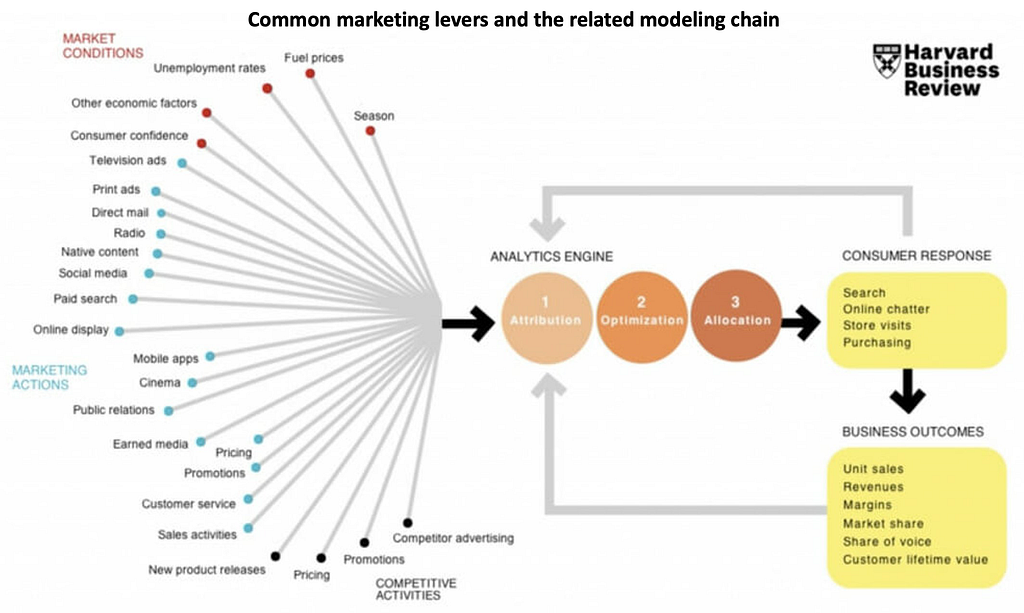
Now, as everyone in digital advertising starts talking about MMM, there seems to be a conflation of the terms of marketing and media mix modeling. While the two are highly related and make of use of similar and in many ways identical methods, they are not the same. A recent report by the Marketing Science Institute nicely brings this point home by distinguishing MMM (marketing mix modeling) and mMM (media mix modeling). The key difference between the two is that MMM really is about supporting a firm’s decisions on the full marketing mix (see Figure 1), so product, price, promotion, and place/distribution, while mMM is about informing its decisions on the media mix, i.e., how it sets and allocates its media budget across media and advertising channels (see upper part of Figure 1).
This blog post aims to achieve three things:
(1) Revisit and summarize differences between MMM and mMM, mostly to help inform current industry conversations in digital advertising;
(2) Talk a little bit about why the concepts of MMM and mMM are often used synonymously and may have fused in digitally native business especially;
(3) Highlight that there may be valuable lessons to be gleaned for digital-first advertisers from the distinction of MMM and mMM.
Differences between MMM and mMM
Both MMM and mMM are analytical approaches used by companies to understand the effectiveness of their marketing and advertising efforts. While they share similarities, they have distinct focuses and differences. MMM is a broader approach that analyzes the overall impact of various marketing elements on a company’s sales and other key performance indicators (KPIs). These marketing elements typically include a combination of the “Four Ps” of the marketing mix: Product, Price, Promotion, and Place (distribution). MMM aims to quantify the contributions of each of these elements, and their interactions, to overall sales.
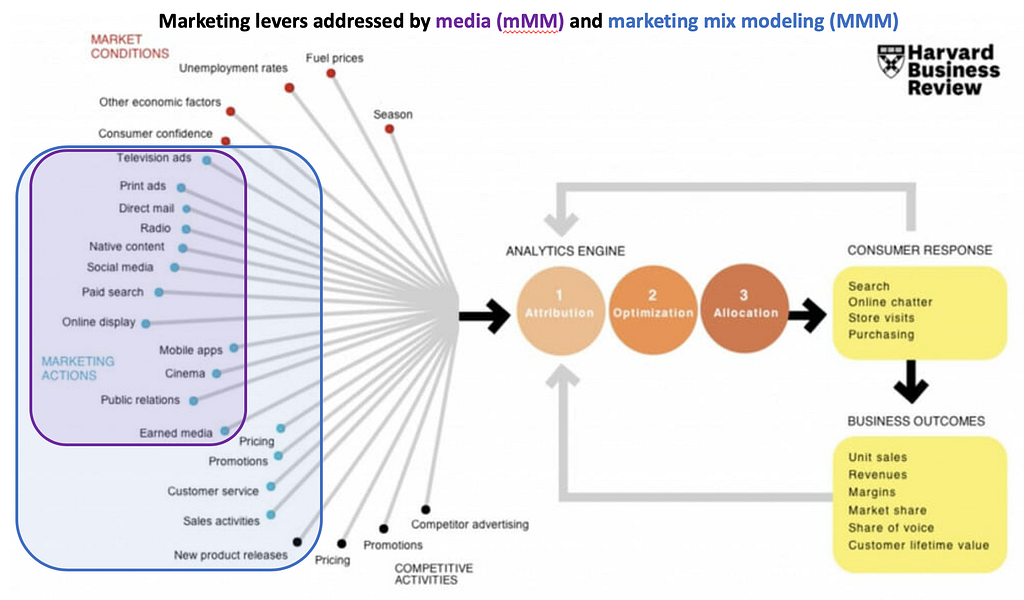
As illustrated in Figure 2, media used for marketing is a subset of all modeling variables used in MMM. In this vein, mMM focuses on analyzing the effectiveness of different advertising media channels in driving sales and other KPIs and determining the optimal allocation of media budget across various channels to achieve the best return on marketing investment (ROMI). It thereby attributes sales or conversions to specific media channels, helping marketers understand which channels are driving the most value. In this way, mMM can sometimes offer insights at a more granular level, such as the impact of specific ad placements, time slots, or online platforms.
Due to their different scopes as shown in Figure 2, the two approaches require different historical data coverage. MMM requires data inputs addressing all the various marketing activities of interest, e.g., on all Four Ps (product, price, promotion, place), in addition to sales data, other relevant external factors (e.g., competitive and macroeconomic), and potentially media spend. While data on the Four P are often added to mMM as control variables, mMM does not require them per se and can work from media spend and sales data alone.
Similarities between MMM and mMM
In terms of model specification and the methodological approaches used for estimation of the models, MMM and mMM lean very similar and often use identical methods. An mMM can also be included in a company’s MMM, meaning a more comprehensive MMM covers media spend evaluation and optimization as a subset of its overall analytical scope. In both MMM and mMM, a simple starting point can be to estimate a parametric model of sales explained by investments in different actions on the Four Ps and in media. Usually, as mentioned above, such a model will also include variables addressing the competitive and macroeconomic landscape. From there, modeling for both MMM and mMM can become more sophisticated by modeling dynamic (e.g., ad stock) effects, interactions between different marketing levers, engineering specific features, using experiments to calibrate the model, and performing other tweaks. More advanced modelers also like to specify, possibly marketing action-specific, response curves that address diminishing returns to scale, e.g., due to saturation of an advertising medium.
While a simple use case of mMM and MMM can be to evaluate past marketing strategy, more advanced uses commonly include forecasting of future sales and optimization of future marketing strategy and actions. These more advanced use cases thereby require explicit assumptions and accommodations in the model. E.g., is the data generating process stationary? Did the competitive or macroeconomic landscape change? Are there new advertising media, product line extensions, or other changes that may require specific adjustments to allow the model to generalize from the past and present to the future? If we increase spending on this medium threefold, how quickly should we expect the returns to that investment to diminish? If we scale down advertising on TV, will sales in the next period be unaffected but may we see a major drop in future periods? If we run large-scale promotions in the next period, how will this in-/decrease and shift our sales between future periods? A model’s architecture will need to be finessed to be able to appropriately reflect these complexities. The larger the model’s scope (MMM > mMM) and the more advanced the use case (optimization > forecasting > evaluation), the more effortful and challenging this task, and the more insightful the resulting model, becomes.
In summary, MMM is a comprehensive analysis of various marketing elements, while mMM specifically focuses on assessing the impact of advertising across different media channels. Figure 2 succinctly captures this difference in analytical scope. Both approaches aim to provide data-driven insights to help companies make informed decisions about resource allocation and strategy in marketing.
Why are MMM and mMM often used synonymously, especially among digitally native advertisers?
By digitally native advertisers, I mean companies that were started and grew with the increased digitization of the production and delivery of consumer goods through the proliferation of the web, personal computers, social media, and then handheld devices. Examples are web-based and mobile gaming companies, direct-to-consumer businesses, app developers, digital (social) media platforms, or e-commerce operations. I believe there are a few factors that may have contributed to a conflation of MMM and mMM among these digital-first advertisers:
- A distinction of mMM and MMM was simply not needed or relevant: Digitally native businesses primarily operate in the digital realm, relying heavily on online platforms, social media, and digital advertising for their marketing efforts. Since their marketing activities are predominantly digital, they often equate marketing with media, considering digital media as the core component of their overall marketing strategy.
- Many digital media are priced “freemium:” Very much related to the previous point, digital consumer goods are predominantly offered under freemium pricing where initial product adoption and use are free. Price hence is much less of a relevant decision criterion for consumers, in turn affecting its importance in a firm’s marketing decision-making.
- Digitization was accompanied by further significant shifts in the salience of the marketing mix’ Four Ps: As freemium pricing reduced the relevance of price in product adoption decisions, promotion is much less relevant as well. Plus, recent research suggests that the effects of price promotions may be very different for digital freemium consumer goods. Distribution collapsed to digital platforms and media or, in direct-to-consumer commerce, was replaced by target advertising and simply disappeared as an essential consideration.
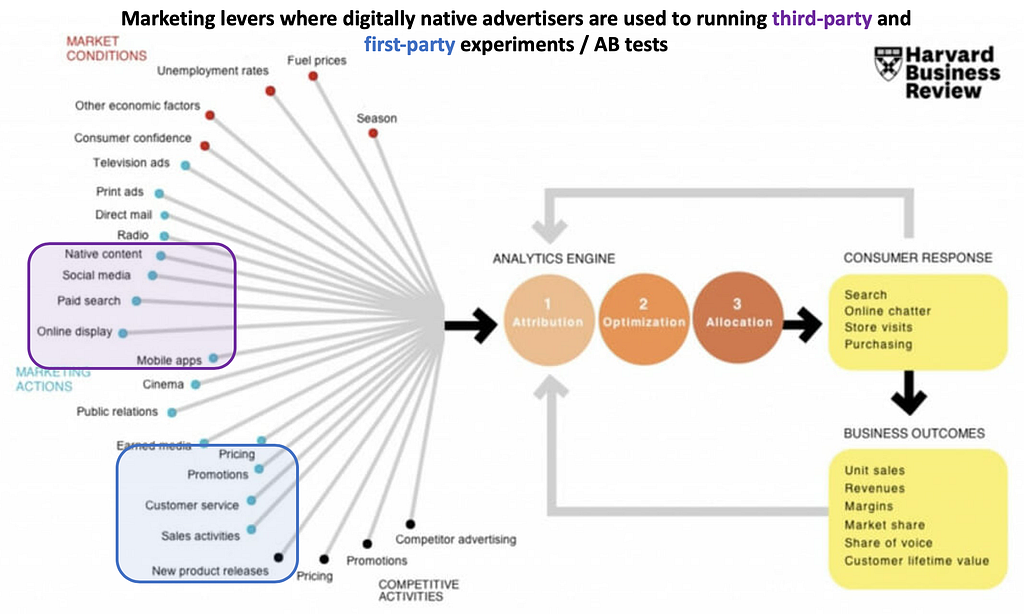
- On digital media, A/B tests and experiments can be conducted with ease: Publishers of digital goods did not need an MMM to inform their product, price, promotion, and place/distribution decisions. As illustrated in Figure 3, they had (and still have) access to granular, user-level data allowing them to run user-level A/B tests and other experiments to inform marketing and product initiatives. A/B tests and other experiments can be run at the user-level to get “gold standard” reads on price elasticity, inter-temporal substitution, and the effectiveness of promotions.
- User-level data enable(d) granular analytics and decision support: Similarly, the available detailed first-party and often third-party data could fuel MTA (multi-touch attribution) models or elaborate product analytics efforts to evaluate and attribute merit to different product and marketing strategies and tactics. In digital advertising, this level of data access is currently under siege (so, for the third-party use cases in Figure 3), but it is likely to remain in place for the foreseeable future for first-party data. Thus, it can continue to support decision-making for product, price, and promotion on a firm’s proprietary digital offerings. When the only reasonable use case of an MMM is to support advertising decisions, it becomes an mMM (see Figure 2).I want to note that, while these factors might lead to the perception that MMM and mMM are the same, recognizing the distinction between assessments of the overall marketing strategy and of media channel allocation holds valuable lessons. A well-rounded approach considers all marketing elements, even in digitally native businesses, to enable a comprehensive and holistic understanding of the factors driving business growth. A more holistic and comprehensive model is also likely to provide more accurate estimates, e.g., of ROMI, for each individual marketing lever. Further, while user-level data and experimentation may still provide more accurate and reliable decision support in product, price, and promotion to digitally native businesses, setting up an MMM to complement, cross-check, and build on these other analytics tools is a worthwhile effort. It can bring “everything together” in one holistic model and provide valuable higher-level insights, e.g., on longer-term strategic and interaction effects that might otherwise go undetected.
TL;DR / Take-Aways
Using the terms marketing mix modeling (MMM) and media mix modeling (mMM) synonymously really is no mistake if you’re running a fully digitally-centric business. Doing so however may lead to confusion (1) when you operate both on- and offline product and distribution, and (2) if you interface with traditional brand advertisers. So, keep the differences between traditional mMM and MMM in mind and see if you can learn anything for your digital-first MMM from “old school” brick-and-mortar marketing mix modeling:
- Could you include data on price and promotion and inform your pricing and promotional strategies from your MMM? Could resulting estimates substitute and complement your existing price and promotion analytics, e.g., by reducing the need to run experiments?
- Are there distribution and advertising channels that you have not considered so far and that could meaningfully increase demand for your product(s)?
- Can a model that more comprehensively addresses your actions on the marketing mix surface insights on synergistic effects that you so far were unaware of? E.g., do promotional efforts increase the effectiveness of your advertising? Is there evidence that lowered prices in certain territories may increase product usage and in turn word-of-mouth in these regions?
In this way, as MMM adoption among digital-first advertisers matures, awareness of the differences between MMM and mMM can open up new pathways for excellence in marketing analytics. Once your mMM is in (a good) place, strive to complement it with an MMM as the next frontier of digital marketing analytics. MMM and mMM can work nicely together: E.g., you can use a more comprehensive MMM to assess your overall marketing strategy and set a media budget that you then allocate based on your mMM. Your media tactics can additionally be informed by further lower-level analytics such as an MTA model or campaign optimization tools. You can also use outputs from granular product analytics and experiments across product, price, promotion, and advertising to calibrate and fine-tune your marketing and media mix model. And you may be able to inform the design of treatments and strategies that you test experimentally using the insights provided by your MMM.

 Julian Runge