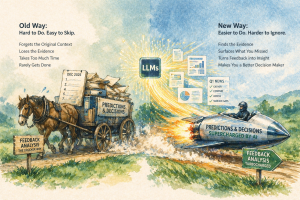
The Verticalization Hypothesis is that MMM engines can be shared across industries, but MMM implementations are usually vertical-specific. Different verticals use different structural forms, measure outcomes differently, and require different controls, data, experiments, and decision workflows.
Contents
- Introduction
- MMMs Used to Be Much Simpler
- The Marketing Measurement Menu
- Making the Verticalization Explicit
- The Coming Demise of the Generic MMM Vendor
- The Emerging Market Structure
- The Verticalization Hypothesis Revisited
Introduction
In this essay, I want to convince you that MMM implementations, more than most analytical systems, are inherently vertical. In MMM, the outcomes, treatment variables, controls, time structure, available experiments, and decision cadence all change with the business. In addition, MMM estimates are interpreted causally and used to shift large budgets among advertising channels. Tailoring the implementation to the business therefore has unusually high value: a structural modeling choice can become a large financial decision.
The Verticalization Hypothesis is that MMM engines can be shared across industries, but MMM implementations are usually vertical-specific. Different verticals use different structural forms, measure outcomes differently, and require different controls, data, experiments, and decision workflows.
The hypothesis has three implications:
- At the engine layer, the software will become open source and shared.
- At the model layer, differences in behavior, marketing mix, data, and decision cycles will require materially different structural forms across verticals.
- At the commercial layer, competitive advantage will shift from proprietary estimation engines to vertical expertise and implementation.
I use three terms in a specific way. An engine supplies reusable computation for estimation, transformations, diagnostics, and optimization. A model is a particular structural specification. An implementation combines the model with the data pipelines, experiments, validation, integrations, governance, reporting, and decision workflow required to use that model in the business.
There will therefore be no universal commercial MMM product. Inference engines will be open source; commercial providers will compete by building and operating implementations whose models reflect the economics and decisions of a particular vertical.
This is the third essay in a trilogy. The first argued that open-source MMM engines will mostly replace commercial ones. The second argued that MMM, as a commercial category, has a measurement problem: buyers cannot easily compare products, claims, or performance before making an expensive commitment.
MMM adoption remains incomplete, particularly as an operating system for budget decisions. Accenture reports that 65 percent of U.S. and U.K. advertisers use last-click attribution to optimize ongoing campaigns. Some may also use MMM for strategic planning, but last-click remains the operating basis for many decisions. The next wave of MMM demand will therefore include both first-time adopters and organizations moving MMM from periodic planning into ongoing use. Both groups need data definitions, experiments, workflows, and decision rules suited to their businesses, which makes vertical implementation especially valuable.
MMMs Used to Be Much Simpler
The earliest versions of MMM were, in broad terms, aggregate market-response models. Neil Borden’s 1964 article The Concept of the Marketing Mix formalized the idea that marketing managers allocate and combine many controllable inputs rather than manage advertising in isolation. At a high level, the question was: Given historical variation in spend, sales, price, distribution, seasonality, and promotions, how much credit should be assigned to each marketing activity?
Early MMM models were built in a world where digital exhaust did not exist, user-level campaign logs were unavailable, and a clean customer-level impression table for every channel was something for the science fiction shelf in the local bookstore. The available explanatory variables were limited to crude measures such as spend, GRPs, distribution, price, and promotions, usually recorded weekly or monthly. Market Response Models and Marketing Practice provides a detailed account of this history.
In mathematical terms, the model could be written as a response equation: sales at time t equal a baseline, plus a weighted sum of lagged media inputs, plus controls for price, distribution, promotion, and seasonality, plus error, as in Figure 1.
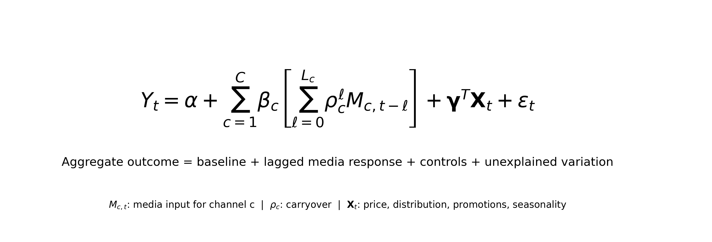
Computational and data constraints kept these models structurally simple. As computing improved and digital channels produced more granular data, nonlinear response functions, hierarchical models, domain-informed priors, and more demanding validation methods became both feasible and useful.
The modern design space is visible in a cluster of Google MMM papers published around 2017 and 2018. Chan and Perry’s Challenges and Opportunities in Media Mix Modeling frames the central inferential problems; Jin et al.’s Bayesian Methods for Media Mix Modeling with Carryover and Shape Effects develops the treatment of lagged and nonlinear advertising response; Sun et al.’s Geo-level Bayesian Hierarchical Media Mix Modeling shows how geographic variation can improve estimation; Wang et al.’s A Hierarchical Bayesian Approach to Improve Media Mix Models Using Category Data extends that logic to related brands and categories; and Chen et al.’s Bias Correction for Paid Search in Media Mix Modeling addresses selection bias in what was arguably the most important digital channel.
Together, these papers show how quickly the basic object changed. MMM expanded from an aggregate response equation into a collection of decisions about carryover, nonlinearity, priors, hierarchical pooling, geographic variation, category-level transfer, and causal adjustment.
Since then, the design space has expanded further. We now have finer-grained measurement, addressable channels, per-creative optimization, platform APIs, mobile attribution systems, data clean rooms, privacy constraints, and the operational ability to start, stop, and reallocate spend almost instantly.
A modern MMM implementation combines causal inference, forecasting, data engineering, budget planning, and experiment design. Each additional function introduces choices that a generic engine cannot make on behalf of every business.
The Marketing Measurement Menu
Because of this expanded design space, a practitioner implementing a modern MMM must make a large number of modeling choices. Together, these choices form the Marketing Measurement Menu. They fall into four groups.
What the model observes and explains
- Measurement unit. Should media enter the model as spend, impressions, clicks, reach, frequency, GRPs, scans, store visits, app installs, or something else?
- Reach and frequency. Should the model treat impressions as sufficient, or explicitly model reach and exposure frequency where the data exist?
- Multi-stage outcomes. Should the outcome be revenue, installs, subscriptions, first purchase, payer conversion, prescriptions, appointments, trial starts, store visits, or a chain of outcomes?
How effects behave
- Carryover form. Should the model include carryover? If so, should it use geometric adstock, Weibull adstock, distributed lags, channel-specific decay, or a more flexible latent process?
- Saturation function. Should channels have a saturation response? If so, should the response be modeled with a Hill curve, logistic curve, Michaelis–Menten-style function, spline, or another shape-constrained form?
- Time-varying baseline. Should the intercept be fixed, seasonal, dynamic, or modeled with something like a Gaussian process?
- Time-varying media effectiveness. Should channel coefficients remain stable, or drift as auctions change, creative fatigues, products mature, and competitive conditions move? If they drift, how should that drift be modeled?
- Trend and seasonality. Should trend, holidays, weekly structure, and annual cycles be handled manually, through Fourier terms, through decomposition, or through an explicit time-series component?
- Spikes and event effects. Should Black Friday, conferences, game launches, influencer drops, sales events, weather shocks, or disease-awareness campaigns be modeled as ordinary controls, structural spikes, or something else?
How the model identifies effects
- Priors. Should priors be weak, domain-informed, channel-informed, experiment-informed, or hierarchical across markets, products, campaigns, or brands?
- Geographic and hierarchical structure. Should the model pool information across geographies, estimate market-level effects, or collapse to a national-level model? Should it contain multiple hierarchies?
- Confounders. Which non-media variables belong in the model: price, promotion, inventory, distribution, competitor spend, macroeconomic variables, search demand, new content, app updates, formularies, payer coverage, or retailer execution?
- Interactions and halos. Should the model allow channel synergies, brand-to-performance effects, cross-product halos, franchise effects, or creative-level heterogeneity?
How claims are tested
- Experiment integration. Should geo tests, conversion-lift studies, randomized controlled trials, interrupted time-series analyses, promo-code analyses, or influencer holdouts be used only for validation, or built directly into the model?
- Validation regime. Should the model be evaluated through in-sample fit, holdout error, time-slice cross-validation, placebo tests, perturbation tests, refresh stability, posterior diagnostics, agreement with experiments, or some combination of them?
The engine can expose these choices, but it cannot choose among them without a theory of the business. The vertical supplies that theory: how demand is generated, which variables are causes or outcomes, which experiments are feasible, and what decisions the model must support.
Frameworks package different subsets of this design space:
- Meridian emphasizes in-house Bayesian modeling, geo-level data, calibration, and reach-and-frequency modeling.
- PyMC-Marketing exposes custom priors, alternative adstock and saturation functions, Gaussian-process components, diagnostics, calibration, and budget optimization.
- Robyn emphasizes saturation, trend and seasonality decomposition, ridge regression, multi-objective optimization, and automated hyperparameter search.
Commercial MMM products sometimes expose components that general-purpose open-source frameworks omit. Recast’s spike functionality, for example, addresses discrete business events that do not behave like ordinary media spend.
To show how deeply these choices depend on the vertical, the next three subsections examine three of the fifteen in detail: measurement units determine what enters the model, outcome metrics determine what counts as success, and experiments determine what causal claims the model can support.
Measurement Units Are Structural Choices
Media variables can enter the model in several forms, but the available choices depend on the channel and the data. In a television-heavy environment, the natural measurement language may be GRPs, reach, frequency, dayparts, markets, and spots. In a digital performance environment, it may be impressions, clicks, installs, spend, SKAN postbacks, MMP events, or modeled conversions. In out-of-home advertising, the nominal exposure unit may be an impression estimate, while a campaign using QR codes on buses may also generate measurable scans. In influencer marketing, the available signal might be post impressions, engagement, promo-code usage, affiliate sales, or nothing very satisfactory at all.
These units occupy different positions in the causal chain. Impressions and GRPs approximate exposure. Spend aligns naturally with ROAS, but it also incorporates media-market prices. Clicks and scans record responses to exposure, although platform and privacy rules often make those measures incomplete. A model using spend therefore partly models prices; one using impressions models exposure; and one using clicks or scans conditions on an intermediate response. The choice of unit determines what the model’s coefficients mean and what question the model answers.
The measurement scale for each unit is also a modeling choice. A log transformation can be attractive because it turns multiplicative relationships into additive ones, allows coefficients to be interpreted as elasticities, and can represent some cross-channel interactions more naturally. But log transformations also create practical and conceptual problems: zeros must be handled, sparse channels become awkward, and the transformation may mask saturation, shifting that complexity elsewhere in the model. Verticals differ in sparsity, the frequency of zero-spend periods, the importance of discrete events, and whether absolute or proportional changes are commercially meaningful.
Choosing among these inputs and transformations requires a vertical-specific account of exposure, response, cost, and the scale on which change is commercially meaningful.
Outcome Metrics Are (Also) Structural Choices
Outcome metrics are just as structural as media inputs. The outcome variable defines what the model means by marketing effectiveness. A model of installs answers a different question from a model of payer conversion or cohort profit; a model of prescriptions answers a different question from a model of patient starts or adherence; and a model of unit sales answers a different question from a model of revenue, margin, household penetration, or market share. Choosing the outcome determines the causal path the model must represent, the relevant time horizon and controls, and the decision the model can support.
The choice often involves a tradeoff between observability and economic relevance. Installs can be observed quickly, while cohort profit may take months to emerge and is often best modeled using predictive functions that can be estimated quickly. Prescriptions may be observed before patient starts or adherence. Unit sales may be available when household penetration or retailer-specific margin is not. An intermediate outcome may be timely but incomplete; the ultimate economic outcome may be delayed, sparse, or poorly measured.
Absolute and incremental outcomes are also different. Absolute sales are the total observed outcome. Incremental sales are the sales caused by media relative to a counterfactual. Historical channel contribution, average incremental return, and the marginal return to the next dollar of spend are different quantities. Adstock represents the persistence of media exposure over time; saturation represents how response changes as exposure or spend increases. With credible causal identification, these structures allow the model to estimate incremental outcomes over time. The slope of the saturation curve is especially important because it determines marginal return at the current spending level.
When a vendor reports channel contribution or average ROAS without exposing its adstock and saturation functions, the client cannot audit the marginal-return calculation behind a budget recommendation. A single experiment can estimate incremental lift at a particular operating point, but it cannot reveal the full response curve.
Selecting the outcome, time horizon, and relevant definition of incrementality requires a vertical-specific theory of the business.
Experimentation Is Part of the Modeling Process
Experimentation has moved from an occasional check on a finished model to an integral part of the modeling process. As Julian Runge and I argued in The Uncomfortable Truth About Advertising Effectiveness: Why Marketers Avoid True Experimentation, observational MMM often cannot separate channels whose spending moves together or establish that an estimated response is causal. Experiments increasingly supply the identification and calibration needed to fit the model. They inform priors, distinguish correlated channels, test response curves, and reveal when a plausible seasonal pattern has been mistaken for a media effect.
Experiments also give executives a reason to trust the MMM implementation when its recommendation is inconvenient. An MMM implementation therefore needs rules for deciding which experimental evidence should calibrate, constrain, or validate the model—and how to resolve conflicts between experiments and model estimates.
A standard holdout estimates causal lift for one treatment contrast at one operating point. It can show the effect of turning a channel off or reducing its budget, but it does not map the full response curve unless the experiment deliberately varies intensity across multiple levels. An MMM implementation therefore needs rules for using evidence from particular operating points to calibrate or constrain the broader response curve.
Those rules vary by vertical. A mobile-gaming company can reduce spending in selected geographies and measure incremental installs, payer conversion, or cohort revenue, although privacy rules and platform reporting limit what it can observe. A pharmaceutical company can vary media across markets and measure prescriptions or intermediate patient and physician actions, subject to regulatory review, privacy constraints, and long response lags. A CPG company can hold out regions or retailers and measure scanner sales, but distribution, stock-outs, promotions, and retailer cooperation constrain the design. The feasible intervention, measurable outcome, and principal constraint are different in each case; the experimentation framework must be vertical as well.
Making the Verticalization Explicit
Mobile gaming, pharmaceuticals, and CPG are all large advertising categories. The following estimates measure different parts of those markets, but each establishes that the vertical can support serious investment in MMM:
- AppsFlyer estimated global mobile-gaming app-install ad spend at $29 billion in 2023.
- IQVIA estimated that pharmaceutical companies spent more than $6 billion on DTC television advertising in 2024.
- EMARKETER estimated that U.S. CPG digital advertising spend approached $50 billion in 2024.
All three verticals care deeply about effectiveness and incrementality, and MMM already has substantial adoption in each. Their models nevertheless take different structural forms. Platform privacy rules, retailer data relationships, and FDA prescription-drug advertising requirements give each vertical a distinct operating environment.
| Dimension | Mobile Gaming | Pharmaceuticals | CPG |
|---|---|---|---|
| Market rhythm | High-frequency acquisition and re-engagement; launches, live operations, and creative fatigue can change performance quickly. | Longer patient and provider journeys; demand depends on disease prevalence, diagnosis, physician behavior, payer access, and clinical positioning. | Retail and category rhythms; promotions, holidays, price changes, distribution, trade spend, and retailer execution are central. |
| Data granularity and decision cadence | Models commonly use daily data; spend may change daily or weekly. | Outcomes often arrive weekly or monthly, sometimes with substantial reporting lags; media decisions follow longer planning, regulatory-review, market-access, and sales-force cycles. | Scanner and retailer data are commonly daily or weekly; tactical decisions may be weekly, while promotions, retailer commitments, and seasonal plans are set farther in advance. |
| Typical media | Paid social, app networks, search, video, rewarded inventory, influencers, CTV, and retargeting where allowed. | TV, digital video, search, condition awareness, HCP marketing, point-of-care media, conferences, and sales-force-adjacent activity. | TV, retail media, paid social, shopper marketing, search, coupons, in-store displays, circulars, and promotions. |
| Measurement systems | MMPs, SKAN, platform APIs, app telemetry, cohort LTV models, event pipelines, and internal BI. | Prescription data, claims data, CRM, sales-force systems, market access data, patient or provider journey data, and compliance systems. | Scanner data, panel data, retailer data, promotion calendars, distribution data, price, inventory, and trade systems. |
| Outcomes | Installs, payer conversion, retention, ROAS, payback, cohort LTV, revenue, and engagement quality. | Awareness, patient inquiries, HCP actions, prescriptions, starts, adherence, persistence, and revenue, often with long lags. | Unit sales, dollar sales, volume, household penetration, share, promotional lift, category growth, and retailer-specific performance. |
| Confounders and constraints | App updates, content releases, competitive launches, auction pressure, platform privacy changes, store featuring, monetization changes. | Guidelines, formulary changes, sales-force coverage, payer access, drug launches, safety news, indication changes, epidemics, and regulatory review constraints. | Price, discounts, feature/display, distribution, stock-outs, retailer compliance, category trends, private label pressure, holidays, and weather. |
| Natural MMM implication | The model must connect media to post-install behavior, cohort economics, privacy-constrained attribution, and fast budget decisions. | The model must handle longer lags, multiple stakeholder journeys, compliance constraints, imperfect observability, and outcomes mediated through physicians, payers, and patients. | The model must separate media from price, promotion, distribution, retailer execution, inventory, and category movement. |
A general-purpose Bayesian engine can estimate models in all three verticals. Specifying those models requires decisions the engine cannot make: whether a mobile game should use cohort-level LTV or a short-window payer proxy; whether a pharma disease-awareness campaign represents media, demand creation, or lagged market expansion; and whether a CPG promotion belongs in price, retailer execution, a structural spike, or the baseline.
Each decision changes the model’s structure, and each depends on the vertical.
The Coming Demise of the Generic MMM Vendor
Shared engines shift commercial differentiation to model specification and implementation, where vertical knowledge matters.
The generic MMM vendor will only survive by becoming less generic.
Supporting another vertical requires another data schema, control set, prior library, experiment program, integration stack, evaluation regime, and decision workflow. The shared inference engine supplies less differentiation with each improvement in open source.
If the vendor’s claim is “we have a better proprietary estimation and forecasting engine,” open source will keep making that claim less persuasive. If the claim is “we know Bayesian inference,” that will not be enough either. Bayesian inference is a tool, not a vertical strategy. Vendors will increasingly compete on ease of integration and on vertical specialization.
A vertical MMM provider knows which data contracts matter, which confounders usually matter, which priors are defensible, which experiments are feasible, how frequently the estimates must be refreshed, and how quickly the business can act on its recommendations. It knows which outputs will be trusted, which outputs will be ignored, and which outputs will start a fight in the next planning meeting.
A vertical modeling and integration specialist therefore delivers three things: a canonical data schema with a default structural form, control set, and prior library; standard integrations and runnable experiment templates; and validation diagnostics, reporting workflows, and performance definitions tuned to the vertical.
The Emerging Market Structure
Commercial MMM historically had two roles: vendor and customer. The vendor sold a proprietary product that bundled the modeling engine, hosting, model design, data integration, and support. The customer supplied data, received estimates, and used the product to make budget decisions.
That bundle is coming apart. The emerging market has four roles: software provision, hosting, vertical modeling and integration, and production operation. A single company or service provider may perform several roles, but customers will increasingly be able to procure them separately.
Software providers build and maintain the modeling engine: inference, transformations, response curves, hierarchical structures, posterior sampling, diagnostics, and budget optimization. This layer is becoming increasingly open source. Shared engines reduce the cost of entering the market and make the estimation code available to hosting providers, specialists, and advertisers.
Hosting providers supply the infrastructure required to deploy the engine reliably. They manage compute, storage, access controls, software versions, scheduled jobs, monitoring, and connections to production data environments. Hosting may be supplied by a cloud platform, a managed-service provider, the vertical specialist, or the advertiser itself.
Vertical modeling and integration specialists configure the engine for a particular vertical. They define the model’s outcome and media variables, structural form, controls, and priors. They also define the experiments, data contracts, and decision cadence around the model and build integrations with the systems used in that vertical. This is where most of the commercial value will reside as the software layer tilts toward open source.
Production operators run the resulting MMM implementation. They monitor incoming data, refresh the estimates, validate the model, reconcile its results with experiments and other evidence, explain changes to stakeholders, and incorporate recommendations into planning. Large advertisers will often perform this role internally, although some will purchase it as a managed service.
Standards and independent evaluation cut across all four roles. They allow buyers to evaluate the software, hosting, vertical modeling and integration, and production process separately, addressing the industry’s measurement problem. Mutinex’s Open MMM Validation Framework is an early attempt to establish vendor-neutral evaluation criteria.
Verticalization and Open Source Reinforce Each Other
Verticalization creates a positive feedback loop around open-source MMM engines. As the software layer becomes open source, vertical providers concentrate on the data schemas, integrations, structural defaults, experiments, and workflows for which customers pay them. General-purpose improvements to inference, transformations, diagnostics, and supporting libraries become shared infrastructure.
That division of labor changes vendor incentives. Contributing a reusable improvement upstream distributes its maintenance and testing across the project. Maintaining a separate engine or long-lived private fork imposes recurring engineering costs without strengthening the provider’s vertical offering. Vertical providers therefore have reasons to contribute bug fixes, engine components, diagnostics, and supporting libraries back to the projects they use.
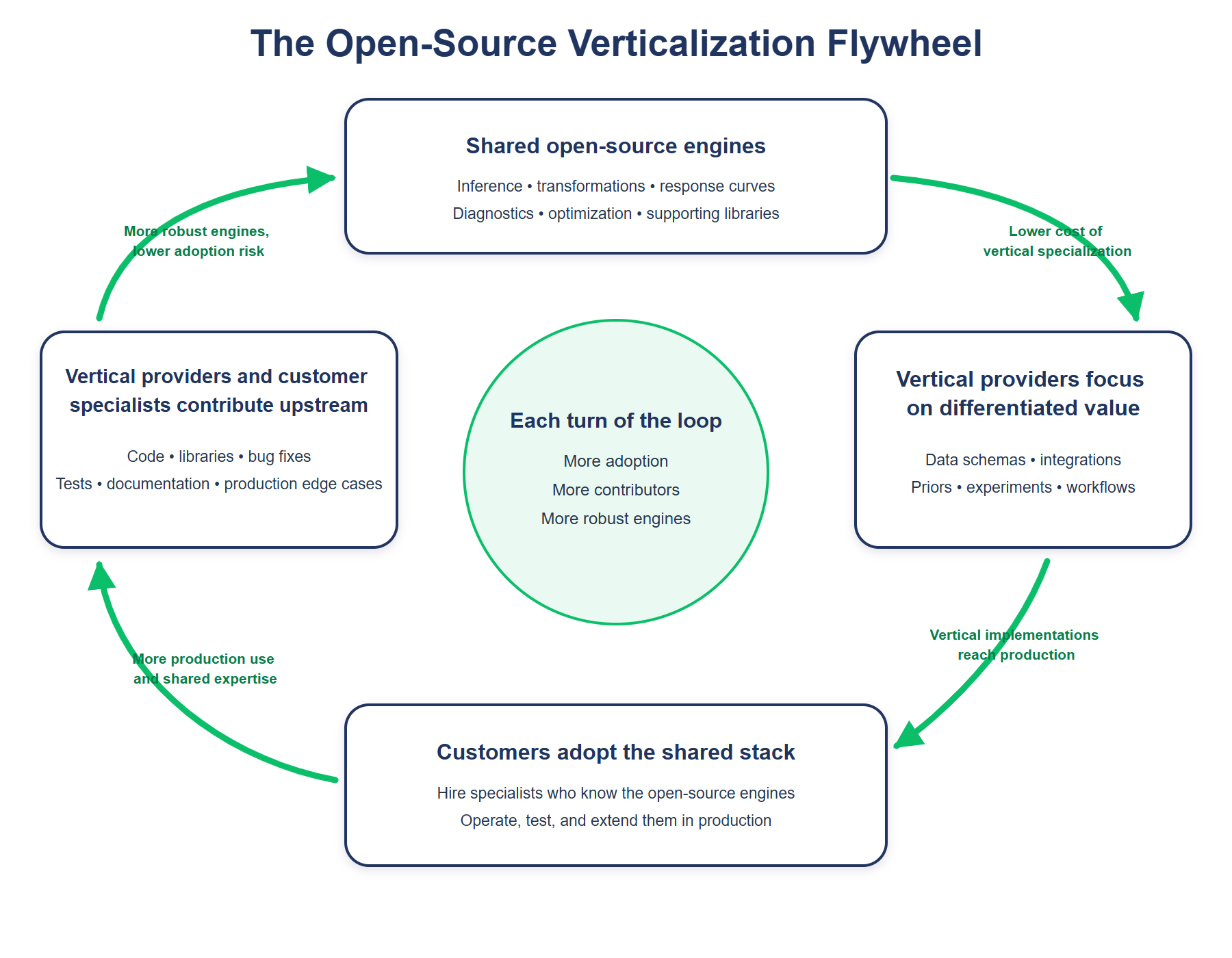
Customers reinforce the loop by owning their implementations and hiring modelers and engineers who already know the open-source engines. Those internal specialists test the engines in new production environments, report failures, contribute fixes, and build reusable tools. The pool of people capable of operating MMM implementations grows with the installed base of the engines.
More vertical providers and internal teams using the engines in production expose more edge cases. They improve testing and documentation, harden the engines against new data conditions, and expand the available engine components. The engines become more robust and less risky. That makes it easier for the next vertical provider to build on open source and for the next customer to adopt it, adding still more contributors and production use.
Each pass through the loop shifts the market further toward open source. Vertical providers create more commercial value by specializing, and their specialization strengthens the shared software layer on which their offerings depend.
The Verticalization Hypothesis Revisited
The Verticalization Hypothesis is that MMM engines can be shared across industries, but MMM implementations are usually vertical-specific. Different verticals use different structural forms, measure outcomes differently, and require different controls, data, experiments, and decision workflows.
As open-source engines make estimation less proprietary, commercial advantage will shift to firms that know how to turn shared engine components into vertical-specific MMM implementations. Generic MMM vendors will have three choices: specialize in a small number of related verticals, become implementation and consulting firms, or watch their core product become a commodity.