Peter Drucker once wrote “The only way to discover your strengths is through feedback analysis. Whenever you make a key decision or take a key action, write down what you expect will happen. Nine or 12 months later, compare the actual results with your expectations. I have been practicing this method for 15 to 20 years now, and every time I do it, I am surprised.”
It’s a simple idea, but in practice it’s surprisingly hard to do consistently. People forget what they thought, lose the original context, or never quite get around to doing the retrospective analysis. But thanks to LLMs, it’s gotten a lot easier.
Here’s what I do:
- I write down predictions in markdown, in a folder on my desktop.
- I give Claude access to that folder.
- Every now and then, I ask Claude to evaluate some of the predictions, in light of what’s happened since then.
Make no mistake– Claude’s analysis is almost always wrong. That’s not the point though. The point is this automates away a lot of the more tedious aspects of retrospective analysis. It is now much easier to take an old argument, prediction, or decision memo, and subject it to a reasonably disciplined review. The LLM manually collects dozens of articles and events, builds a rough chronology, and writes up a synthesis from scratch.
Note also this this is made vastly more powerful if you integrate MCP servers for all your productivity and management applications (e.g., you let Claude read Slack). To my mind, this is one of the most compelling reasons to hook up AI to your productivity tools.
Here’s a worked example, using ChatGPT.
In December of 2025, I published Seven Things That Are Absolutely Going To Happen in 2026, a piece containing seven predictions about the gaming industry. A few months later (instead of waiting until year-end), I used AI to ask a narrower question: how are these predictions doing so far? The prompt was straightforward. I asked for the ten most relevant Q1 news articles for each prediction, followed by a short, evidence-based assessment of whether the prediction appeared to be on track, plus a list of the top things I had missed.
Figure 1 is the summary table from that analysis.
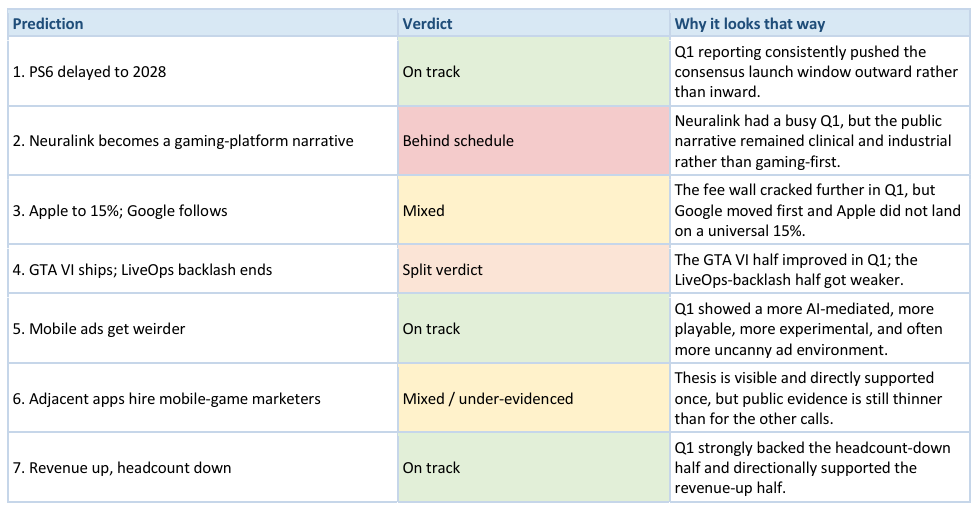
(complete review available on request).
Here’s the prompt I used (GPT 5.4, Pro, Extra High):
Last December, I posted 7 predictions for video games in 2026. We’re now heading into April and, well, I’m wondering how I did. Can you, taking the point of view of a unbiased observer who is an expert in the space, find me the 10 most relevant news articles from Q1 for each prediction, and then give me a 2 paragraph opinion — how am I doing so far, does it look like things are on track, and what’s the evidence. Separately, I would also like a list of the Top 5 things I totally missed on. the post is: https://gamedatapros.com/seven-things-that-are-absolutely-going-to-happen-in-2026/
A mere 54 minutes later, I had a nicely formatted word document discussing my predictions and pointing out potential flaws in my thinking process. Mind you, I disagreed with ChatGPT’s analysis in several key areas. But that’s okay– the important thing is the evidence based analysis of my thinking, not whether or not ChatGPT was right.
Going back to the original point. The same process can, and should, be applied to pricing decisions, product bets, user acquisition strategy, organizational design, or almost any other domain where someone forms an explicit expectation about the future. If the original reasoning is written down clearly enough, AI can help retrieve comparable cases, gather subsequent evidence, summarize what happened, and identify tensions between expectation and reality.
That, to me, is the real opportunity. Drucker’s method was always a good idea but it was rarely practiced because it required taking good notes and then doing a tedious amount of boilerplate tracking-things-down. AI makes it much easier to run this kind of evidence-based retrospective and that means that one of the oldest ideas in management is now much more practical.